My brick wall is James Smith. Could it be any more difficult or common than that? Just the surname Smith is bad enough but add the given name James! I can go back many generations on many other lines of my family but James Smith is my shortest lineage and a 26 year road block.
SO here is the problem. My James Smith is like all the other James Smith. There were thousands of James Smiths in 1809 in America. They all seem to have had sons named William, John, James, Joseph, Charles, and Henry. James first son was named William which leads me to think that his father may have been a William Smith. Try looking for a William Smith. Try looking for James when the birth year is different on each census records. Try looking for him when death records of his children report that he was born in different states. Try looking for a “Needle in a Haystack”. I guess you understand why my blog is named what it is.
James died in 1868 before Indiana issued death certificates. He is buried in the Nine Mile Cemetery with several of his children; Barbary, Charles H. and Kisiah whose deaths preceded him. They are all listed on one large stone. The year that Barbary was born and died is unknown. It is believed to have been after 1857 and the baby died at eight months old. She was likely one of the earliest graves in the cemetery. The property was deeded to the church and the church found in 1853. Kisiah died in 1861 at the age of nineteen.

Mary Ann and Susannah’s stone is growing out of this tree.
Another daughter, Mary Ann Smith Kimble and her daughter Susanna died in March and May of 1863 and were also buried in the cemetery in the Smith plot. Mary Ann and her husband Jonathan, had lived in Fort Charlotte, Ohio according to the 1860 Census records. Charles was also buried in 1863. I have scoured the Civil War records to see if he was a causality. I do find a Charles Smith from Indiana who died in 1863 but I can not confirm that this is the Charles Smith that I am looking for. Enlistment records don’t quite give you enough information to positively identify someone.
The church has very few of the original burial records. The county has transcripts of all the stones. The Smith stone in question was in multiple pieces for many years.

Top half of the Smith Stone

The bottom half of the Smith stone with the children’s names on it which was still in the base.
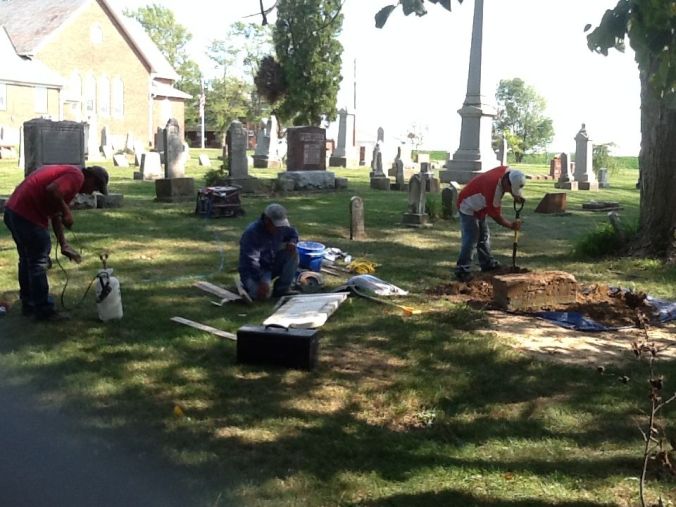
Mark Davis and his crew from Stone Saver Cemetery Restoration working on this tombstone.
There were so many pieces that I thought there were two stones, Mark Davis from Stone Savers Cemetery Restoration fixed the stone for me and it was determined that it was one large stone. Mark and his crew did a great job and his company restores old pioneer cemeteries all over the state of Indiana.
Susanna, James’ wife, was supposed to have been buried with him. Her name is on the stone but there are no dates or age at death to signify that she was actually buried there. The church has no record of her being buried there. She may have died as much as twelve years later. She was found in the 1870 Federal Census and not in the 1880 Federal Census.

James Smith is the reason I did DNA testing. In 2010, I did my first series of DNA testing. It was costly but I was so hopeful that is would eventually help me. My Brother did the Y-DNA test and I took the mtDNA. My test showed that our Maternal haplogroup was H (the Colonists) which meant nothing to me then. I had great hopes that my brothers Y-DNA 46 test would be lots of help. I patiently checked for matches but the Ancestry database was pretty small in 2010. The test results told us that our haplogroup was Rb1, the Artistans.
Ten years ago, DNA tests were very different than today. Besides the fact that they cost a lot more, you had a variety of tests you could choose from. You could purchase a 12 marker test, and 24 marker test, a 46 marker test or a 64 marker test. ( I think those were the number of markers)The larger the number of markers tested the more accurate the test. Or so I was told. I opted for the 46 marker test in hopes that it would give me more data to work with. At that time the database overall was pretty small in comparison to today. It matched me up with Musgraves, Shepards, Stephensens, Adams, and others names which I no longer remember. I wish I had recorded them, but the reality was there was not a single Smith!
Somewhere in the 2012 time frame, Ancestry decided that they would change the number of markers that they would examine for DNA testing to a standardized amount. They claimed that they were over testing for what would work best for the majority of the population. As I recall they standardized their testing to accurately predict for 5 generations. I was notified but I did not understand what they were telling me.
I had contacted some of the people that were early matches and we never really figured anything out. But I did not record that data because I thought it would always be available through Ancestry. At some point I went out to Ancestry and I could see my brother’s raw test results but it was no longer being compared because the database had been changed and there was nothing you could compare it to. I boycotted redoing the test for many years but eventually gave in and redid my test in 2018 getting the results in 2019.
Years ago I loaded the raw data from my brothers test into a couple of other databases. None of them are as large as Ancestry’s database today but I eventually got one hit. It has told me one thing. He is likely a half brother or first cousin to a Smith Family group who left Darke County in the 1830’s. This family settled in Benton County, Indiana. There are some people on Ancestry that believe that they have identified James’s father but my one DNA match says that it is not him. I have asked each of these researchers for the source data which they used to make this connection and I have not gotten an answers. I keep looking for matches. I have some from the descendants of James and Susannah but James’ father and mother still remain a mystery after 26 years.
Happy Hunting,
Jan
#52ancestors
 Needles in a Haystack
Don’t give up. My father’s surname was Martin and there’s a ton of those out there. Surprisingly, we followed the breadcrumbs left by my Kansas grandmother and ended up tapping into a Kentucky line that took us back to colonial times.
LikeLike
Oh no…I won’t… I am hooked. I keep looking…
LikeLike
I hear you about the last name Smith! My Mother’s birth father is a Smith as well. Makes things a bit more challenging!
LikeLike
yes it does indeed..
LikeLiked by 1 person