52 Ancestors in 52 Weeks – Week Eight – Prosperity – Part 2

52 Ancestors in 52 Weeks – Week 8 – Part 2

Another look at Prosperity ….

Back in the winter of 2017, I came across an a smart phone app that I thought might help me break through some of the brick walls which i had in my family history research. Some where in my research I came across a blog post which talked about a new smart phone app that Ancestry had made available, called “We’re Related”.

At this time in my research I had hit a lull. I was not finding much in the way of new information. I just was not making much headway with my research. It seemed as though I kept looking at the same data over and over again.

SO I looked into  the new app.  I discovered that it was a data crawler type application. When I worked in the computer industry, programmers used them to search for data in a company network or on the internet. The program looks at a set block of data, in this case, your family tree, and searches all the databases it can find for any data that matches the data in your tree and then reports the matches back to you.

So I loaded the app on my phone and started it. The criteria was that you need a smart phone with the “We’re Related” app loaded, an active Ancestry.com account and a family tree loaded on Ancestry.  So I got my most current family tree loaded. I had always used my father as my home person in my tree. Well, that played havoc with the app and made it difficult for me to know who was related to who so after a few weeks of running the app, I made the home person ME and restarted the app and the data began to flood in.

At first I was able to look at the data as I got it, do a bit of research and I could tell if it was accurate or not.  One database that is used for the comparison comes from user submitted family trees. Some user trees have mistakes in them. You must always double check data for accuracy.  What I liked about the data that I received  was that it gave me clear paths for research. It would give me a linage of a famous person and it would show me how the app determined how I may be potentially related to them. I was able to prove the accuracy of the data or in some cases disprove the connection.

Now at this point I need to remind you that the search algorithm will continually search. Eventually, I was receiving so much data, I could not keep up . I started a spreadsheet. I put all the Maternal data in one and the Paternal data in another and I based my daily research on data from these spreadsheets.  As time went on my hits did become less frequent but I still got some weekly.

I knew that I was not the only researcher using this tool and I could not help but wonder what all these data crawler search algorithms were doing to the Ancestry.com databases and their network. I presumed that it was this app that assisted in the research that was being used for the Television show “Who do You Think You Are?”

My interest was not so much in the famous people that I was possibly related to, though it was mildly amusing, my interest was in the people within my linage that they identified but I had not found yet. It was these people who were my brick walls and with this new information I was able to break down some of those walls. It was these people that I focused my day to day research on, proving that I was or was not related to them.

Last summer I finally replaced my old smart phone with a new one. When I went to the app store to look for the “We’re Related” app, it was no longer available. My search algorithm and all of the hundreds of thousand of others must have been too much for Ancestry’s network. BUT I have a spreadsheets of data that I have saved that I still use for research.

Listed here are a few of the families connections that I have found through the use of the “We’re Related “ App. They are early Colonial Family who go back to nobility in England, Ireland and Scotland. They are on both sides of my family. They were prominent colonial families in these early settlements and some were appointed to leadership positions in the early colonial government.

leet-coat-of-arms-leet-family-crest-6

Governor William Leete (1612-1683)

William Leete (1612-1683) was one of these early setters. He arrived with Rev Whitefield’s company and was one of the early Plantation Covenant signers while still aboard the ship on June 1, 1639. They arrived in New Haven (Connecticut) a month later on July 1. He was one of six men selected to negotiate a land treaty with the native tribes for the purchase of the land for the new settlement. The new settlement consisted of several planned plantations.

William was called upon to serve many public offices in the early colonial settlements which later became Connecticut. He was the clerk of the New Haven plantation from 1639 – 1662. He was appointed as a deputy to the colonial court representing the plantation of Guilford until 1650 and was then appointed magistrate of Guilford from 1651-1658. In 1658, he was appointed Deputy Governor until he was elected Governor of the plantation in 1661. He held the office until 1664 when the plantations of Guilford, Stamford, Milford, New Haven and several others, merged and became the colony of Connecticut. After these plantations merged, he served as an assistant until he was elected as deputy governor. He was elected as Governor in 1669 and served in that capacity until his death in 1683. This family connection is on the father’s side of the family.

While investigating the Leete side of my family, I found church records which enabled research to date back several more generations in England. William’ s 2X Great Grandfather is Thomas Leete(1520-1582) he was married to Lady Dorothy of Warde.   (1528-1587) It is because of the connection to nobility that ensures that there are records that can be found. Thomas and Dorothy are my 12 times Great Grandparents.

Thomas Leete(1520-1582) => Thomas Leete(1554-1616) => John Leete (1575-1648) => Governor William Leete (1612-1683) => Andrew Leete => (1643-1702) => William Leete (1671-1736) => Roland Leete (1708-1767) => Ashel Leete => (1755-1791) => Jonathan Leete (1775-1861) => Nancy Leete (1814-1900) => Austin Boyer (1848-1908) => Mae Eveleen Boyer (1883-1914) => Lillian Losee (1905-1980) = Harold Smith (1929-1996) => Janet L Smith.

In this same area of Connecticut in the same time period as Governor William Leete, I have found several lines of my Mother’s family as well. I have spent considerable time researching the Reynolds family connection.

df8c527dd3e59e97b1518b6528610ef6

George Reynolds was an interesting character who is well researched. His life was documented by his youngest son, Jay Lincoln Reynolds. My family descends from Georges oldest daughter, Sarah Louise Reynolds Densmore, who was 22 years older than Jay Lincoln, her brother. George ‘s wife, Margaret, died when the youngest son, Jay, was four years old. Jay Lincoln spent much of his young life being raised by older sisters. He spent months and sometimes years with each of his sister and blended into their families. He had frequent visits from his father and as a preteen he returned to the live with him during the final years of George’s life. The eleven year old Jay and his eighty year old father cared for each other. It was of this time period that Jay Lincoln fondly, chronicled his fathers life.

The Reynolds family is traced back to my 9th Great Grandfather, George Reynolds born in 1555 in Kent, England. His son, John Reynolds came to America as a freeman in 1635. He settled in Watertown, Massachusetts before leaving to settle in Stamford, Connecticut within a year or two of his arrival. The “We’re Related” app was my connecting source which enable me to validate the link back from William Reynolds to George Reynolds of 1555.

George Reynolds (1555-1634) => John Reynolds (1590-1664) => John Reynolds (1638-1701) => John Reynolds ( 1674-1750) => John Reynolds (1699-1789) => William Reynolds (1735-1810) => George S Reynolds (1774-1874) => Sarah Louise Reynolds (1836-1918) =>Charles Densmore (1864-1943=> Addie Densmore (1890-1955) => Leah Anderson (1928-2009) => Janet Smith

William Reynolds, my 4 X Great Grandfather and the father of George S Reynolds, was married to Elizabeth Mudge. Elizabeth’s family can be traced back to Jarvis Mudge who was born in England in 1608 came to America from England by the time of 1638 when his name is found in Court documents in Boston, Massachusetts. He was among the founding members of Hartford, Connecticut.
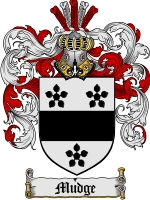
mudge-coat-of-arms-mudge-family-crest-7

Elizabeth Mudge’s father was Micah Mudge and her mother was Lucy Spencer. The Spencer’s are well documented back to 1015AD. This is likely the same Spencer family that the Princess of Wales, Diana Spencer descends from. There are several databases who document Royal families and Nobility in Europe. One such database I could follow back to a thirty-three times Great Grandfather through this Spencer line. I found this interesting but the volume of work that it would take to prove its accuracy was daunting. I was able to prove the validity for several generation but have so much other work to proof that this can be left for a later date if I ever pursue it.

Micah Mudge’s Grandfather was Micah Mudges and his wife was Mary Alexander. Mary Alexander’s family come from the Alexander Noble family from southern Scotland. They family is well documented in the Royal database as well. They descend from the ancient McDonald clan who lived in southern Scotland near Edinburgh and Glasgow at the time of William the Conqueror.

alexander-coat-of-arms-family-crest-1

SO as you can see that data crawler program spit out enormous amounts of data for me to work with. It did nothing for my biggest dilemma, my Smith Family! There are just too many of us. We are all common folks. We are not celebrities. We make up a vast population of people whose surname were derived from their occupation and it is known that immigrants who want to start over in American sometimes just declared themselves a “Smith”.

Happy Hunting,

Jan

52 Ancestors in 52 Weeks- Week Eight- Prosperity – Part One

Prosperity is a noun which is by definition  a the state of being prosperous;  Wealthy, successful, profitable, affluence, the good life, good fortune, life of luxury, plenty….. according to the web site http://www.dictionary.com.

This is another interesting and thought provoking topic this week. I like to give my self time to think about the weekly topic. This week my first thought was…I have nothing to write this week!

Most of my ancestors were common hard working people. They came to America looking for a better way of life. They certainly hoped for prosperity, a good life and maybe a bit of good fortune that they believed they could not find where they were living. They came looking for a piece of land that they could own or a job that they could do to provide better living conditions for their family. They were looking for opportunities that for one reason or another had eluded them in their homeland. They were hopeful, hard working people.

They received land, improved it and farmed it. They were people who provided basic services that enriched the lives of others. They were blacksmiths, wagon makers, tailors, cobblers, inn and store keepers, milk maids, circuit riders and clergy. They worked on the early railroad and in the auto industry. They were builders, masons and years later, electricians and plumbers.
And when they needed to fight for the freedom that their newly adopted country brought to them, they did. They served in the Revolutionary War, the War of 1812 and the Civil War. They were the common folks who thru hard work and dedication to freedom contributed to the forming of this great country of ours. They were all very prosperous people in their own right. They may not have fit the definition that I listed above in the eyes of other people but in there own eyes and mine, they were prosperous.

52 Ancestors in 52 Weeks – Week 7 – Favorite Discovery

This is a hard topic because in 24 years of this journey, I have had many favorite discoveries! Each favorite discovery was the catalyst for the next favorite discovery but I will today try to focus on the events that lead up to one of my earliest ones. This discovery came in 2003 along with the another favorite discovery, the fact that my Smith Family ancestors were instrumentally involved in the founding of the the Nine Mile United Methodist Church in Indiana. Of the sixteen found members, twelve of these members were directly connected to our Smith family.

In 2003, I had been visiting my son and his family in Michigan. I was living near Chicago at the time. On my return home, I decided to take a detour. Instead of exiting I-69 onto I-94 and heading west to Chicago, I decided to continue south to Fort Wayne, Indiana area. Nine Mile Indiana is just south and west of Fort Wayne. I had made good time so far on my journey home. I had no deadline for getting home and I calculated in my head that I could spend an hour or so trying to find this church and the graveyard that I thought my Ancestors may be in.

NineMIle United Methodist Church-2

So I headed south and after about 30 minutes or so found my exit, then the church and graveyard. The graveyard was a good size but I went in search of the oldest stones in the cemetery. It was then that I found James Smith and his children, Mary Ann, Kesiah, Charles, Barbary and a granddaughter Susannah. I had taken some pictures and wandered the cemetery for a bit to see if I found any familiar names. After thirty minutes or so I thought I ought to get back on the road.

As I was getting ready to leave, a nice woman came from the house across the street to see me. It turned out that she was the pastor of the church. We visited briefly. I explained what I thought was my connection to this area and the church. She asked if I wanted to go into the church, she would unlock it for me. I told her that I would love to. I asked if there was a restroom that I could use before I started my journey to Chicago. It would surely take me a bit longer to get home now. I would be traveling on I-80 across Northern Indiana before meeting up with the interstates that circle around the Chicago area. The interstates near Chicago would be like parking lots, jammed with commuters trying to get home from work and the last thing I would want to do is be looking for a restroom in  traffic jam!

I entered the church and found a lovely sanctuary for worship. It had beautiful windows and a wonderful painting behind the alter. I sat quietly in the pews feeling a special energy as it surrounded me. The tears flowed peacefully down my cheeks. I was moved in a way that I had never felt before. People were speaking to me and assuring me that I belonged there. Minutes drifted, five minutes, ten minutes and before I knew it I had sat there thirty minutes lost in my thoughts. It was as if a strong magnet kept me firmly planted on that pew. In that moment I knew this would be a place I would return to again and a again.

I left the peace of the sanctuary to see if I could find the restroom. The pastor had told me it was down in the basement in the far corner. So I followed the stairs down into the dark abyss of the basement. Placing my hands on the walls, feeling my way down the stairs, I carefully stepped on one stair at a time with the hope of finding a light switch. At the bottom of the stairs, I found one. I flipped the switch and it turn on a ceiling light in the middle of the fellowship hall. Just enough light to show me a path to the bathroom door across the room.

The room was your typical fellowship hall with a small kitchen area and several tables for people to gather. It looked like they were used regularly for what appeared to be adult christian education or Bible study. Nothing seemed to be geared towards children’s Sunday school lessons. To my right as I exited the restroom towards the stairs, I could see something hanging on the wall. I decided to find a few more light switches to get a better look at this room. Once I found them and turned them on, the room was now nicely illuminated. My attention was drawn back to the wall next to the stairway.

Exif_Jpeg

Hanging on the wall was a 1906 quilt made by the Ladies Aid Society. My other passion in life is quilting. I had trouble containing my own excitement. I stepped forward to get a better look at this quilt. The blocks were called Crazy Quilt Blocks which were common at the turn of the century. There really wasn’t a pattern for each block. They just kept adding fabric until the block was the size that they wanted. Then the blocks were sewn together to form the quilt.

Much to my surprise, each small piece of fabric in the 20 blocks of this quilt had a name or two hand embroidered on it. At this point in my search, I did not know for a fact that this was my family church but the energy in my body told me that it was! So I got my camera out once again and started taking pictures. First the whole quilt and then close ups of each of the blocks. I had to record this information. I did not know who on the quilt would turn out to be related. This was a snapshot of the people who belonged to this church in 1906. A snapshot of the people who lived in this area 59 years after my family came to the area and formed this church.

I spent the next few weeks and months trying to record all the name on each block. There are one hundred and twenty three families and two hundred and sixty three church members listed on the quilt. My intention was and still is some day to put these families and this quilt in a book.

By now, my quick hour long detour has lasted for several hours, much longer than I had planned but every minute of my time spent in that church that day is today cherished as a favorite discovery!

Happy Hunting,

Jan

When I went to write this post I realize that I did not have all the photos of the blocks on my external photo  drive. It may be that they are not in digital form.  They may been some of the last prints that I had developed and maybe hanging out in a photo book somewhere. It was about this time when we bought a new camera which enabled us to save our photos digitally on out computers.  If i can not locate them then it looks like I will need to take a road trip this summer to get these pictures. It has been a while since I have visited my family church.

#52ancestors


52 Ancestors in 52 Weeks

My brick wall is James Smith. Could it be any more difficult or common than that? Just the surname Smith is bad enough but add the given name James! I can go back many generations on many other lines of my family but James Smith is my shortest lineage and a 26 year road block.

SO here is the problem. My James Smith is like all the other James Smith. There were thousands of James Smiths in 1809 in America. They all seem to have had sons named William, John, James, Joseph, Charles, and Henry.  James first son was named William which leads me to think that his father may have been a William Smith.  Try looking for a William Smith. Try looking for James when the birth year is different on each census records. Try looking for him when death records of his children report that he was born in different states. Try looking for a “Needle in a Haystack”. I guess you understand why my blog is named what it is.

James died in 1868 before Indiana issued death certificates. He is buried in the Nine Mile Cemetery with several of his children; Barbary, Charles H. and Kisiah whose deaths preceded him. They are all listed on one large stone. The year that Barbary was born and died is unknown. It is believed to have been after 1857 and the baby died at eight months old. She was likely one of the earliest graves in the cemetery.  The property was deeded to the church and the church found in 1853. Kisiah died in 1861 at the age of nineteen.

Exif_Jpeg

Mary Ann and Susannah’s stone is growing out of this tree.

Another daughter, Mary Ann Smith Kimble and her daughter Susanna died in March and May of 1863 and were also buried in the cemetery in the Smith plot. Mary Ann and her husband Jonathan, had lived in Fort Charlotte, Ohio according to the 1860 Census records. Charles was also buried in 1863. I have scoured the Civil War records to see if he was a causality. I do find a Charles Smith from Indiana who died in 1863 but I can not confirm that this is the Charles Smith that I am looking for. Enlistment records don’t quite give you enough information to positively identify someone.

The church has very few of the original burial records. The county has transcripts of all the stones. The Smith stone in question was in multiple pieces for many years.

J-S-BarberrySmithcp-2

Top half of the Smith Stone


Exif_Jpeg

The bottom half of the Smith stone with the children’s names on it which was still in the base.

Stoneplacement-Aug-2012

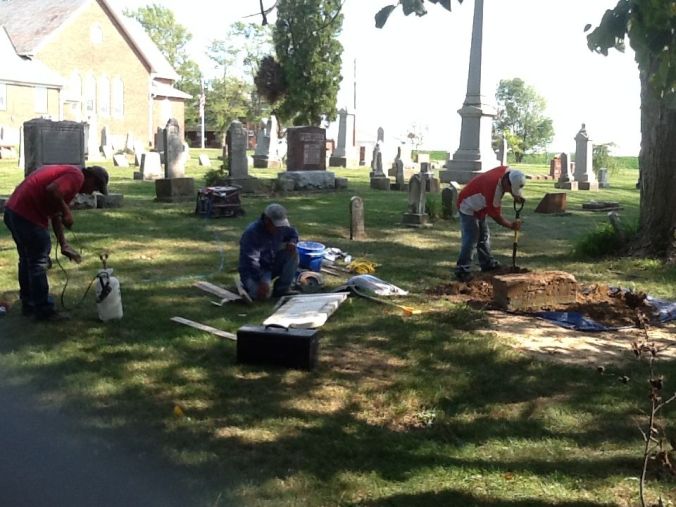
Mark Davis  and his crew from Stone Saver Cemetery Restoration working on this tombstone.

There were so many pieces that I thought there were two stones,  Mark Davis from Stone Savers Cemetery Restoration fixed the stone for me and it was determined that it was one large stone.  Mark and his crew did a great job and his company restores old pioneer cemeteries all over the state of Indiana.

Susanna, James’ wife, was supposed to have been buried with him. Her name is on the stone but there are no dates or age at death to signify that she was actually buried there. The church has no record of her being buried there. She may have died as much as twelve years later. She was found in the 1870 Federal Census and not in the 1880 Federal Census.

James Smith-NineMile

James Smith is the reason I did DNA testing. In 2010, I did my first series of DNA testing. It was costly but I was so hopeful that is would eventually help me. My Brother did the Y-DNA test and I took the mtDNA. My test showed that our Maternal haplogroup was H (the Colonists) which meant nothing to me then. I had great hopes that my brothers Y-DNA 46 test would be lots of help. I patiently checked for matches but the Ancestry database was pretty small in 2010. The test results told us that our haplogroup was Rb1, the Artistans.

Ten years ago, DNA tests were very different than today. Besides the fact that they cost a lot more, you had a variety of tests you could choose from. You could purchase a 12 marker test, and 24 marker test, a 46 marker test or a 64 marker test. ( I think those were the number of markers)The larger the number of markers tested the more accurate the test. Or so I was told. I opted for the 46 marker test in hopes that it would give me more data to work with. At that time the database overall was pretty small in comparison to today.  It matched me up with Musgraves, Shepards, Stephensens, Adams, and others names which I no longer remember. I wish I had recorded them, but the reality was there was not a single Smith!

Somewhere in the 2012 time frame, Ancestry decided that they would change the number of markers that they would examine for DNA testing to a standardized amount. They claimed that they were over testing for what would work best for the majority of the population. As I recall they standardized their testing to accurately predict for 5 generations. I was notified but I did not understand what they were telling me.

I had contacted some of the people that were early matches and we never really figured anything out. But I did not record that data because I thought it would always be available through Ancestry. At some point I went out to Ancestry and I could see my brother’s raw test results but it was no longer being compared because the database had been changed and there was nothing you could compare it to. I boycotted redoing the test for many years but eventually gave in and redid my test in 2018 getting the results in 2019.

Years ago I loaded the raw data from my brothers test into a couple of other databases. None of them are as large as Ancestry’s database today but I eventually got one hit. It has told me one thing. He is likely a half brother or first cousin to a Smith Family group who left Darke County in the 1830’s. This family settled in Benton County, Indiana. There are some people on Ancestry that believe that they have identified James’s father but my one DNA match says that it is not him. I have asked each of these researchers for the source data which they used to make this connection and I have not gotten an answers. I keep looking for matches. I have some from the descendants of James and Susannah but James’ father and mother still remain a mystery after 26 years.

Happy Hunting,

Jan

#52ancestors

52 Ancestors in 52 Weeks – So Far Away – Week 5

The topic for Week Five brought to mind the members of my Norwegian family and the fact that they were sailors.

Until I started this family history obsession, or mission, I really did not think about careers that could separate you from your family.  My father had a retail business . He came home very night after work for dinner and returned to his job the next day. He repeated the process six days a week thorough out his career. Farmers work their land, long hours tending crops and animals but in the end they sleep in their own beds and eat dinners at their own tables. My Grandfather on my father’s side was a minister. His Sundays were very busy.  The rest of the week was spent preparing for Sunday, ministering and take care of his church members and their families but once again he was able to return home and sleep in his own bed at night.

Sailors get on a ship and sail out to sea for months or even years at a time. They are constantly working. The ship doesn’t stop and anchor for the night. It moves 24 hours a day seven days a week. The sailor will get short periods of down time when they can catch a few hours or maybe just minutes of sleep or eat a quick meal made by someone on the ship. A sailor must always be at the ready. If the seas are rough, there will be no dinner or sleep until the seas calm down. There is always a crew manning the ship.

So now, lets talk about the sailors in my family. There is my Great Grandfather, Hans Andersen and his two sons, Andres and Hagbart.   On the small island where they lived, at the turn of the century, there were very few choices of occupations. One was a framer but you must own some land to be a farmer. You could be a shopkeeper but you needed a building to run your business out of.  Or you could work on a ship and be a sailor. You did not have to own a ship. The Captain of the ship owned it and they were always looking for a crew. It was the nature of the business.

Hans was a sailor. Listed below are a transcript of Hans’ voyages. Some of the names of the ships and destinations I can not decipher. I did my best trying to translate them. I was sent this document by the great niece of the woman who became Hans’s second wife, Mathilde Zainer.

Her great niece’s name is Inger Zainer. She is very active in the local Tjome Historical Society. We met online first, as I tried to get someone to translate some postcards for me. She very generously volunteered to do so. We met in person in 2017. She arranged for us to go into the home which Hans and our family lived in. It was a moving experience to say the least.

Hans Voyage Transcripts came from a database which contains what appears to be data from a Norwegian agency which recorded official records of all the ships, sailors, ports of call and who they sailed for throughout their careers. As a sailor, they did not get a job with one ship and sail just on that one ship. They sail on different ships from one season or voyage to the next.

Hans the Sailor

Hans’ Voyage Register and timeline of life events

March 31, 1880 – Aboard the ship Rebekka from Svelvig, Norway to America returning to Drammen, Norway on September 3, 1880

October 15, 1880 – Aboard the ship Geo Washington from Tonsberg, Norway to Hamburg, Germany returning to Tonsberg on November 23, 1880

March 29, 1881 – Aboard the ship Salo from Tonsberg to America returning to Tonsberg on December 14, 1881

On February 7, 1882, Hans Henrik married Ingeborg Lansrudattra. (this is of course not apart of the registry but I place it here as a timeline for the reader)

IngeborgHansAnderson1880-2

Ingeborg and Hans – Wedding Photo -1882

March 30, 1882 – Aboard the ship Salo from Tonsberg to America returning Tonsberg on September 17, 1882

June 2, 1883 – Aboard the ship Thorbyerg from Tjome to England returning to Tjome on January 14, 1884. There are no details about the numbers of ports the ship visited.

On September 16, 1883, Andres was born in Tjome while Hans was at sea.

March 31, 1884 – Aboard the ship Waaberanker from Tonsberg to Larvig returning to Tonsberg on August 21, 1884.

March 25, 1886 – Aboard the ship Nina from Tjome to America returning to Liverpool on April 4, 1887.

June 28, 1887 – Aboard the ship Gorille from Tonsberg to Rochefort, France returning on December 6, 1887

March 3, 1888 – Aboard the ship Norway bound for America returning April 2, 1889 to Sandefjord, Norway

On September 12, 1888, Jakob Hagbart was born in Tjome and Hans was at sea.

July 22, 1889 – Aboard a ship (possibly the Winnepeg) sailing back to Rochefort, France returning to Tonsberg but no date is given.

April 29, 1889 – Sailing aboard a ship whose name I can not figure out. It returned on August 6, 1889 and leaving again returning on September 7,1889. No port of call were recorded in this line in the record.

January 28, 1891 – sailing on what might be the the Enterprise out of Tjome to the United Kingdon on June 2, 1892 to Grenada i the Caribbean.

On September 9, 1891, Haakon Ingwardo was born in Tjome. I can not be sure if Hans is home or not at the time of Haakon’s birth.

June 23 1893 – Sailing outbound and returning on February 2, 1894.

April 5, 1894 – Aboard the Sir John Lawrence to the UK and on to Grenada returning to Tjome on March 21, 1895.

On September 18, 1894, Hans’ wife, Ingeborg , died of TB. Based on the record above Hans’ was at sea for nearly a year before returning home. He would have learn of his wife’s death upon his arrival home in March of 1895. Hans’s mother, Olava Jorgansen, cared for her grandsons after their mother died.

IngeborgHelene1890-2

Andrew’s mother – Ingeborg – 1890 – a picture  that Andrew carried with him to America of his mother taken shortly before she died.

March 28, 1896 – sailing on the Sir John Lawrence out of Tjome to the UK and the record seems to indicate that he did not return until February 18, 1897. While he was sailing his young sons were in the care of his mother, Olava.

On March 18, 1898, Hans married his second wife, Mathilde, Zainer.

YoungMathilde

Mathilde Zainer

June 4, 1898 – Sailing outbound  for places unknown and returning on November 3,1898.

April 13, 1899 sailing aboard the Hovding returning December 2, 1899.

After 1899, Hans retired and returned permanently to his home on Tjome. He bought a sailboat that he used to take tourist out into the Oslo Fjord during the summer on day trips. He also took fisherman out to fish but now he is home each night.

Andres the Sailor

It is at this time that Andres  began to his career as a sailor.  He completed his primary education at the Tjome school in 1898 and the 1900 census lists Andres in Hans’s family but it indicates that he is an apprentice seaman working on a ship called the Alma which is registered in Tonsberg but he is working out of London. The record indicate that he is in his second year of his training. Andres sails out of London for the next four years. After a trip to America, he decided to immigrate. He arrived at Ellis Island on April 1, 1904.

Anders-2

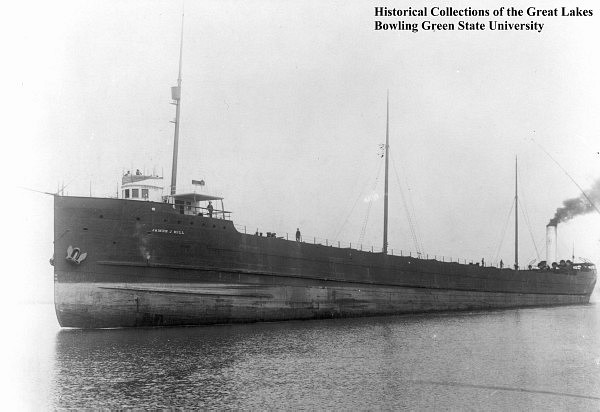
Andrew, as he is known in America, begins working on the Great Lakes under the direction of Gustav Englehart. He works on the Steamer Geo King in 1908. The Geo King is moving trees from Duluth, Minnesota to lumber mills in Michigan. By 1909, Andrew is working on the William Edenborn according to post cards that he received.

SteamerEdenborn

Steamer  William Edenborn

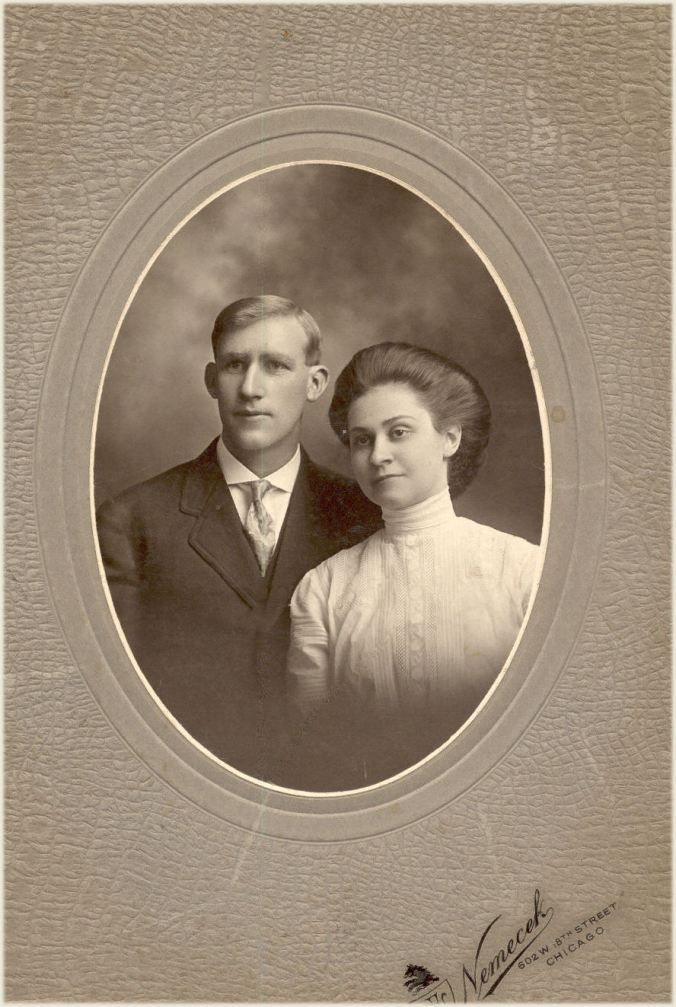
On December 9, 1909, Andrew married Addie Densmore and at that point it must have been obvious that he was planning to stay in America for good. Andrew and Addie spent the first few months of their married life in Chicago Harbor “keeping ship” on the “Henrietta” which was moored there for the winter. Addie signed on as the Ship Cook the first year that they were married. They had their wedding photo taken in Chicago.  Addie worked as the ship cook  until she became pregnant with their first child, Olga.

AddieAndrewWedding2

Andrew when back to working on the Steamer Geo King until 1911 when he signed on as a crew member of the Steamer Walter Stranton.

WalterScranton-empty-2

Walter Scranton

At this point I can not tell you exactly how long of a stretch Andrew was at sea for sure. It was weeks at a time and sometimes months but since he sailed in the Great Lakes and not in the Oceans it was not nearly as long as his father had.

AndyAndersonCrew-edit

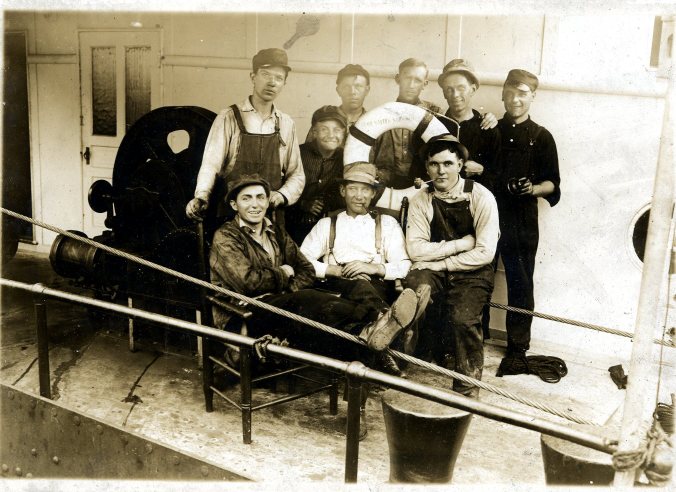
Andrew and his ship mates on the Walter Scranton

Andrew continues to sail until 1918. His draft record for World War I indicates that he now works for the Electric railway which runs from Port Huron to Detroit.

Hagbart the Sailor

Hagbart-2-crp


Hagbart finished his schooling in Tjome in 1904. At that time he became an apprentice seaman who worked out of London just as Andrew did. He sailed for four and a half years in the North Atlantic before taking a crew position on a ship which sailed to New Castle, Australia. This would be an extended voyage that would likely last a year or more Hans and Haakon impatiently awaited a letter from Hagbart once he arrived in Australia but the letter did not come. After nearly a year, Hans received a large package which contain the unopened letters which he had sent to Hagbart. There was no explanation in the package. He knew then that there as something very wrong. Several weeks later he received a letter from a crew member on Hagbart’s ship with the sad news that Hagbart had become sick with a fever as they rounded Cape Horn in southern Chile. He reported that Hagbart was sick for two weeks and they were no where near land. He died on  March 13, 1909 on the ship and was buried at sea.

Being a sailor took all the Andersen men so far away from their homes.

Happy Hunting,

Jan


52 Ancestors in 52 Weeks – Week 4 – Close to Home

What comes to mind for me when you say “Close to Home” is when families stay in the same general area for several generations. When grandchildren and grandparents grow up and old together. When cousins grow up together and are your first and longest friends. When adult siblings remain close and they often are doing things together. In 2020, I believe that this is a rarer occurrence than ever. The small towns of America just do not have the jobs that can support families. Adult children need to move to locations where they can find good employment opportunities. Retirees move to the small towns where the cost of living becomes more affordable.

I have found through my family history research that our families were wanderers. Searching for that right place to raise families. We have many lineages who have moved to another county, state or territory in search of a better life. We will look at one family today and their descendants.

James and Susannah (Overly) Smith and their fourteen children were a prime example of a wandering family.  They were from Darke County, Ohio and they left Ohio for Indiana between 1843 and 1847. James W Smith was the last child born in Darke County, Ohio in 1843 and John F. Smith was the first born in Nine Mile, Indiana in 1847. The older adult children moved with their parents but most of them stayed a very short time in the Nine Mile, Indiana area before moving on.

Margaret Smith married Benjamin Davis after his first wife died in 1851. Benjamin, his wife and family had come from Darke County with James and Susanna along with several other families. In the 15 years that Margaret and Benjamin were married, they had 6 children. Benjamin had six children from is first wife. His three oldest children were married before Margaret and Benjamin were married but the three youngest were raised by Margaret. Margaret died in her mid thirties after the birth of her last daughter, Elnore in 1866 and prior to Benjamin Davis marriage to Hannah J Spencer in 1868. I have not found the exact date that Margaret died. With the death of Margaret, Hannah now raises Margaret’s children and two of her own.

Mary Ann Smith married Jonathan Kimble in Pleasant township, Allen County, Indiana in 1852.  They had their first son, Jacob in Indiana in 1853 before they moved to Pickaway County , Ohio.  By the 1860 Census, Mary Ann has had three additional children who were born in Ohio. It appears that Jonathan and Mary Ann return to the Nine Mile area when Mary Ann and her daughter Susanna became ill.   Mary Ann and her daughter, Susanna died in 1868.  They were both buried together in the Nine Mile Cemetery with the rest of the Smith family members.

Sarah married Robert Hood and they settled in Columbia City, Whitley County, Indiana. Sarah and Robert Hood had three sons; Robert F., James A., John William. James died at 2 months old. Sarah died in 1873 at the age of forty.

The Smith brothers, William and Branson along with several of the Benjamin Davis’s adult children moved to Madison County, Indiana in the late 1850’s and early 1860. They settled in Pendleton and married two sisters, Hannah and Emily Kinnamon.

Charles Smith died in the Civil War and a daughter Kisiah died a short time after Charles. They are both buried with their father in Nine Mile Cemetery.  Joseph Smith moved to the Grand Rapids area of Michigan with his sons after the death of his wife in 1890. John Franklin and Henry Charles have been very elusive. In the 1900 census, I find John F Smith living with his niece, Dora E Whitely in Grant County, Indiana. He is listed as single, never married.

Of all of the adult children of James and Susanna, only three remained in the Fort Wayne area to raise their children. My two times Great Grandfather was one of those three remaining adult children.

James W Smith FamilyCP

The James W Smith Family –  1909 

Front row: James F. Wert, Lulu Etta Wert, Alvin Sparks, Everett Smith, Virgil Sparks, Talmedge Sparks, Nora Sparks, Ethel Straley

Second row seated: Ruth Jackson, Dora Smith Jackson, Cora Crites Smith holding James Fredrick, James W Smith, Oella Denny Smith, Dessie Heckman holding Virgil.

Row three standing: William H Jackson, Alvin O Smith, William Sparks, Della Smith Sparks, Oscar Jackson, Homer Wert, William F. Smith, Francis W. Smith, Arena Straley Smith.

James and his wife Oella (Denney) Smith had five children who they raised near Nine Mile, Indiana.

William F Smith was a farmer who lived in nearby Wells County. My Great Grandfather, Alvin Smith and his wife, Cora Crites and their two children left the Fort Wayne area in 1919 for Flint Michigan where the new auto industry was flourishing and providing many new opportunities for employment. Alvin landed a job at the auto plant which today is the GM Truck plant. By 1920, Alvin’s brother Francis also came to Burton and became an auto worker too. In 1925, Alvin who was 51 years old, had a fatal heart attack while working the assembly line.

Cora and her sons, Everett and James Fredrick remained in Burton, Michigan. Everett became a minister and Fred followed in his fathers foot steps by working his entire career in the auto industry.

Everett-Marine CityParsonage-Crop

My Grandfather was Everett Smith. Everett’s ministry took him and his family to three Michigan counties during his career; Genesee, Lapeer and St Clair counties. In today’s mobile environment these three Michigan counties are relatively close together but in the mid 1930 through the late 1950 they were quite a distance apart. He was ordained in the Methodist church. They moved every few years as the Methodist Church found new places that he needed to attend to. He served in 8 churches in three counties. Everett and his wife Lillian had two children. Their first daughter Lucille died when she was six years old. Their second child was my father, Harold.

Harold met my mother Leah while his father was the minister at the Marine City Methodist Church. When they married, they lived in Lapeer near Everett and Lillian for four years and Harold worked in retail for J.C. Penney.  In 1955, shortly after I was born they moved to Romeo, a small farm town in Macomb County, Michigan, where Dad found employment with a family run clothing store called Egelstons.

We moved into a new small rural subdivision built by the Fritz Family and lived on Fritz Drive. We had no family nearby.  Our Grandparents live in opposite directions thirty miles away. We had no cousins on my fathers side of the family. My Mother was one of eight children so we had many cousins on her side but we lived so far away that we only saw them for special family events.

Our neighborhood was filled with young families who had come from all over Michigan or even from around the country to fill jobs being created by industries that were directly or indirectly related to the automotive industry. These young families became our friends, our cousins, if you will. The Randalls, the Jacobsens, the Trombleys, the Hughes, the Deaners, many of whom were are still friends with sixty years later.

Happy Hunting,

Jan


52 Ancestors in 52 Weeks – Week 3 – Long Lines

52 Ancestors in 52 Weeks – Week Three – Long Lines

LongLine

Long lines … interesting.    Long lines could mean a lot of things.

Return lines at Walmart after Christmas.

Or check out lines at a grocery store before a good winter storm in Michigan.

Or lines at a gas station in the south before a hurricane.

Or the dreaded TSA lines at the airport or customs lines

In genealogy or family history, long lines can have a few different meanings too.

Ancestors who were all fisherman, preachers, career military, scholars, teachers, lawyers, shop keepers, inn keepers, farmer,  patriots, government officials, statesman, Earls, Dukes!

Or your long lines can be lineages, lengthy lineages…

So lets look at my mother’s side of the family.

In Norway…

Soren Ostre Kjole (1565-1604) – 9th Great Grandfather

Anund Olsen Sevik (1613-1697)  – 8th Great Grandfather

Ole Evansen Vestgarden (1620-1680) Kristi (1630-1693) – 8th Great Grandparents

These Norwegians are all fisherman.

In the Netherlands…

Andries Van Valkenburg (1540-1609) Lea Kittel (1560-1609) – 11X Great Grandparents

He was a nobleman.  This family left the Netherlands but at this time in history the borders between Germany and the Netherlands changed often  depending upon which warring faction raided the area this week.  In the midst of the Palatine persecution, Many Germans/ Dutch people left for safer countries.

In England…

Sir John Reynolds (1590- 1641) Sarah Chesterfield (1614-1657) – 8th Great Grandparents

Sir George Reynolds (1555-1634) Thomasyn Church ( 1566-1634) – 9th Great Grandparents

Sir John Spencer (1300-1386) Alice Deverell – 18th Great Grandparents

Sir Richard Deverell (1275-) – 19th Great Grandfather

Sir Richard Polard (1278) – 19th Great Grandfather

John Bailey ( 1618-1696) Lydia Backus (1637-1696) – 8th Great Grandparents

Henry Baylie (1583-1638) Elizabeth Reade (1590-1620) – 9th Great Grandparents

William Backus (1606-1664) Elizabeth Ellen Cook (1603-1643) – 9th Great Grandparents

Sarah Moss – 10th Great Grandmother

John Alexander (1603-1677) Agnes E Graham (1597- 1677) – 9th Great Grandparents

Sir John Thomas Graham (1573-1626) Margaret Ruthven ( ) – 10th Great Grandparents

John Pratt (1565- 1619) Elizabeth Webb (1567-1615) – 9th Great Grandparents

William Gooden ( ) Elizabeth White (1591-1676) – 9th Great Grandparents

Robert White (1558-1617) Bridget Allgar (1562-1605) – 10th Great Grandparents

Edward Dix ( 1616-1660) Deborah (1615 ) – 8th Great Grandfather

Anthony Dykes (Dix) (1580-1638) Tabitha Pittman (1605-1688) – 9th Great Grandparents

John Perry ( ) Judith Vassell (1582- 1650) – 10th Great Grandparents

John Vassell (1573-1625) Anna Russell (1549-1593) – 11th Great Grandparents

Lord Jean de Vassal (1519-1612) Anne Hawes (1528-1545) – 12th Great Grandparents

Frances Russell (1527-1585) Margaret St John (1524-1594) – 12th Great Grandparents

John Burnham (1500- ) Dorothy (1501-) – 11th Great Grandparents

Thomas Andrews (1512-1593) Anne Wiley (1544-1633) – 11th Great Grandparents

Johane (Thomas) Franklin (1514-1570) Alice Alme (1525-1622) – 11th Great Grandparents

And on my father’s side of the family….

In Germany ….

Jacob Cruetz (1680-1753) Maria Catherine Pette (1685-1719) – 8th Great Grandparents

Hans M Raupp (1623-1694) Anna Catharina (1625-1683) – 9th Great Grandparents

Hans Simon Nagel (1623-1693) Catharina (1625-1691) – 9th Great Grandparents

In England….

William Dudley (-1684) Jane Lutman ( ) – 9th Great Grandparents

Edward Slade ( -1604) – 12th Great Grandfather

Sir Thomas Leete (1520-1582) Lady Dorothy of Warde (1528-1587) – 12th Great Grandparents)

Robert Shute (1530-1590) Thomasine Burgoyne (1527-1577) – 11th Great Grandparents

George Strong (1556-1636) Ann Bond (1560-1628) – 11th Great Grandparents

Deacon William Holton (1608) Mary Winche (1612-1691) – 9th Great Grandparents

All the English ancestors listed for both the paternal and maternal side of the family are early Colonial Settlers and /or their parents who may have remained in England. These that came to the colonies all arrived as free man and many are or have ties to nobility which is why the families have been painstakingly recorded. Peasants have much less accurate information. This is by no means a complete list but I thought it was enough for illustrate some “long lines”.

All the German/ Dutch ancestors left due to warring factions and instability in their home countries and promises of a new beginnings in the colonies. The Dutch and German except for nobility, came as indentured  settlers who became free after several years of dedicated service to colonies and the current Crown.

I had not really looked at theses lines for a time and was pleasantly surprised how many there were.  A number of years ago, I used a iPhone App called “We’re Related”.  It was a Metadata Crawler program which once started just continually ran comparing your tree data to other data on Ancestry.com. It was an app under the ancestry.com umbrella of tools.  Much of these long lines were established  through the use of this app and then researched to verify the accuracy of the data.

I have a new phone and I can no longer find the app in the app store.  I am not surprised the app is no longer available.  I am certain that the app reeked havoc with Ancestry’s network.  It was good while it lasted.  After the first year, I was so overwhelmed with data, that I started a spreadsheet and maintained it for  few years. All that data is now a part of my research pool.  When I have extra time or a research puzzle.   I dig into that data, use ancestry, familysearch.com and all my other tools.

So there you have it…a few on my “long lines”.

Happy Hunting,

Jan

52 Ancestors in 52 Weeks – Week #2- Favorite Photo

JOHN&EMMA CRITES4

Emma (Amanda) and John Crites my 2X Great Grandparents

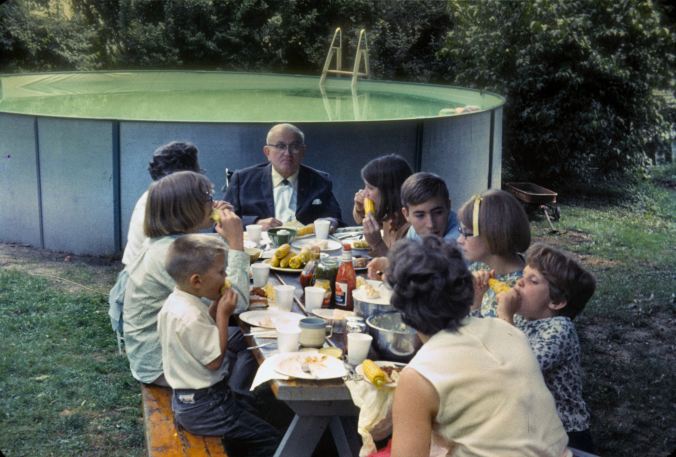
Family Photos had an important place in my journey into our family history search. They were a launching pad that laid quiet for twenty nine years.  The launching pad’s foundation was laid one summer day at the picnic table in the back yard of our home in Imlay City.   We were having a picnic.  My Father had gone to Detroit to get his parents and bring them to Imlay City for the day.  Grandpa had MS and was wheelchair bound. They lived in a retirement home that would enable them to have a somewhat independent living environment but also give Grandpa the 24 hour a day medical care that he needed.   It was an early version of the assisted living type centers of today.   Grandma brought a large box of old dusty photos with them.

After eating our picnic lunch, Dad went back to work at the dime store, Mom went off to do dishes and Grandma brought out the box!  It would be her job for the day and I soon learned that it was mine too.  It was one of the last boxes that she needed to go through since they moved there five years before.  “Janet, I need you to help me” she said.   “Darn it”  I thought. I had lingered at the table just a few minutes too long.   “I need you to write on the back of these photos for me. ”  she exclaimed.  “Why do I have to?” I whined.  She  stated that my handwriting was better than hers.  And with that I was stuck for the next couple of hours being her scribe!

SmithPicnic-1968

Smith Picnic – 1968

She dumped the content of the box of photos on the table and it created a nice size pile. I thought this is going to take hours!  I sat at the picnic table with Grandma Lillian and Grandpa Everett and we sorted through old photos. The Photo’s were of people from a long time ago.  Faces I had never seen, young and old, in small towns in front of unknown houses. They were of Grandpa’s  family, the Smiths, his parents, grandparents,  his uncles, aunts and assorted cousins. It was almost like a game. Grandma would show Grandpa the photo like a flash card and he would tell us who it was.  She would hand the photo to me to write the name on the back.  So I wrote the names that I heard; McGoogan, Wert, Sparks, Meeks, Crites, Jackson, Smith and Denney. I wrote them on the photos in my 13 year old hand writing. Most were misspelled but I was in a hurry! I had better things to do, you know!

JOHN AND EMMA CRITES-UNIONDALE,IN

John and Emma Crites – Uniondale, Indiana

Some time later, Grandma went thru the photos again and wrote notes on the back trying to describe the family relationships. Notes like Grandpa Crites’ sister, Everett’s favorite Cousin, Grandma Crites’ mother. All added to assist someone to understand who these people were many years from now when she and Grandpa were long gone and someone decided to look at the old photos in this dusty box.

Twenty nine years later, I decided to add the people that I “know” to a family tree in Family Tree Maker. I had bought Family Tree Maker for my husband for Christmas. He had been using an old DOS based software for his family information.  My father had died the year before and I thought it might be a good idea to take a look at this while my mother was still living.

I was trying to figure out who Grandpa Smith’s parents were and where they came from. Grandpa Smith told me that he was born in Indiana, I remembered that much. I talked to my Mother and she tells me that she has this dusty old box of photos that were Grandma and Grandpa’s. My next visit to Michigan, we got the photos out. As I search through the dusty box, I was startled by handwriting on the back of the first photo. Chills ran up and down my back and tears began to well in my eyes. Suddenly I was flooded with the memory of the afternoon at the picnic table with Grandma and Grandpa. I am in awe as I notice that Grandma wrote on the photos too. Grandma was talking to me loud and clear.

She sent me research hints to find twenty nine years later. Some of the hints sent me on wild goose chases and some goose chasing were of my own doing when I spelled the name wrong but each stoke of her pencil and mine gave me a place to start. After spending an hour or so with the box, I realized that it was much smaller than I had remembered. And there weren’t THAT many photos! Oh what I would have given to be able to ask Grandma and Grandpa some questions now. I was so lucky to be able to spend “that time” with my Grandparents that day. It was a gift that I will always cherish.

If you are the keeper of your family history, make sure you find someone to share it with a generation or two younger than you. Even if they do not seem as interested in it as you would like. It is important for these memories live on. Label your photos and make sure the young children in your family hear the family stories so they can understand and experience the joy of keeping the memories of their ancestor alive.

How my Grandmother knew that I was the one who would take on this mission, I’ll never know but she knew. Thank you, Grandma Lillian! I love you too!

Lillian@GmBoyers2

Lillian Losee Smith at about the age 10

Having to pick one favorite photo is really difficult because I love them all.  The all speak to me at high volume!

Happy Hunting!

Jan

Communication with Relatives Across the Globe – 1900-2020

In the last 120 years communication around the globe has really changed. I wish I could tell my Grandfather how easy it is to talk to our cousins in Norway in 2020. I just meet a new one on Facebook this week!

Grimestad-300001

This birthday greeting came from Andrew’s Grandmother, Olava, for his 25th Birthday in 1908

My Grandfather, Andrew Anderson left Norway and arrived in America in 1904. Through the years he was in contact with his family through letters which at times of good/bad news were fairly frequent but at other times were scarce. He often received a post card like this birthday greeting from his Grandmother in the early years in America.

During WWII any mail sent to or from Norway was subject to search by the Germans who occupied Norway. If the mail was deemed inappropriate, it would be confiscated. The following is an envelope from a letter which Hans sent to Andrew. In the letter he tells of his wife’s death just before the war. He assures his son that he is in good heath and safe. The seal on the envelope allowed the mail to continue on it way to America and proves that it was read.

Hans-e2-1940003

After Andrews father died in 1946, Andrew seem to quit communication with his sister-in-law, Anna, for a time. Anna had legal obligations that she had to do to close Hans’ estate. She pleaded with him for answers. She was left in Norway to handle these details with Andrew in America and Haakon in Japan. Her requests seemed to go unheard by Andrew. She begins to think she doesn’t have the right address.

anna-envelope-1946

Haakon was a fairly frequent writer from China and Japan. Being a missionary and away from his family for long stretches of time, letters were his only way of communicating. Andrew seemed to answer his letters but it may have been his wife, Addie who was pushing him. Haakon wrote to him in Norwegian so he had read them, Addie could not. When Addie died, Andrew wrote his brother. As the years went by so, the length of time between letters grew and the communication became less and less.

haakon-letter47

When Andrew died in 1971 and my mother found his letters from Norway which of course were in Norwegian and she was unable to read them. They were wrapped in a bundle and placed in his top drawer of his dresser. She had found an address for Anna, the woman she knew who was her Aunt so she sent her a note to tell her of Andrew’s death. She had no way to know if she would get it or not. It was returned, address unknown and was lost.

In January of 1972, my Mother got a phone call from a man in Minnesota who introduced himself as “a cousin of Sigrunn Ingwardo”. Mom did not recognize the name except Ingwardo .  He explained that she had married my mother’s cousin, Bjarne Ingwardo. Now that name she knew was her cousin in Norway. Bjarne and Sigrunn were planning a trip the America to visit family in Minnesota and were hoping that they could visit Bjarne’s family in Michigan also while they were in America. This January phone call established contact with the Norwegian and American cousins after a decade of silence.

Bjarne and Sigruun came that summer to visit and we all had a wonderful time getting to know each other. Before Bjarne and Sigrunn left to go back to Norway, my parents had already made plans to visit Norway the next summer. I was married and had a nine month old son so I stayed with my siblings while Mom and Dad took their trip. Mom and Dad met the whole family including the children.  My Father took a lot of photos.

IngwardoSmith-1973-cp

Front Row: Knut, Leah (Mom), Anna, Rita Standing ; Nina, Elin, Anna Maria, Elsa’s husband, Elsa’s daughter and her son, Sigrunn, Elsa, Harold (my Dad) – 1973

Soon after this trip that my younger sister, Sharon and our cousin Rita became pen pals. For several years Rita and Sharon corresponded regularly.

My Mother was finally able to give Anna the news of Andrews death and we were given the news that Haakon had died the year before Andrew.  My Mother corresponded with her Aunt Anna after they returned but eventually Aunt Anna died and the letters stop too.

In 1997 I started my family history search adventure. It was after my Dad had died in 1996. About 2000, I started working on the Norwegian side of the family. I used a tool that I frequently used on RootsWeb. I posted a message on a Norway message board trying to locate Ingwardo family members in Olso. Within 24 hours, I had a response. A kind fellow Norwegian researcher, gave me postal addresses and a couple of email address.

The first email I had was to Olaf Ingwardo. Olaf was Bjarne’s older brother, I remember him from my Mother and Dad’s trip. I sent him an email and explained to him who I was and that I was trying to connect with my Norwegian relatives. We conversed quite regularly for about 18 months.

He caught me up on the family news. He told me about his three daughters and their families. He told me that Bjarne  and Sigrunn had divorced. and that he had moved to Copenhagen and had married a Danish woman. He told me that Sigrunn had died. He told me that he had divorced.

Through our email conversations I determined that he seemed angry and a bit bitter. in one email I wanted to talk to him about his father who had been a missionary in China.  I got an earful. I learned that I had to be careful with the topics of our conversations. He was bitter about the German occupation of Norway during Worlds War II, Anna and her children were in Norway and Haakon was stuck on China. Life was difficult for Anna and the children in Oslo. My Mother was still alive then and I told her about what Olaf had said. She said that they had been warned when the visited Norway that Olaf was bitter about the war and it was probably not a good conversation topic…

All the while that Olaf and I are conversing I assume that he is sharing news about the relatives in America with Bjarne and his sisters. One day he sent me a short email.  He told me that he was going to have to go to the hospital. I knew that he had some medical issues but did not know anything specific. I told him that I would pray for him and that unleashed a scathing email about God. I was stunned. He was convinced that there was no such thing as God or why would he have placed Anna and the kids in Norway and Haakon in China during the war. I was speechless. I did not know what to say. It was the last email I received from Olaf.

I waited about three weeks and I sent an email stating that I hoped he was ok and recovering…no response. Waited another three weeks, no response. Sent an apology, no response. After many months of no response I wondered if maybe he had died. So I went out to my Rootsweb Message board and sent a message looking for a Ingwardo in Denmark. Once again, within twenty four hours I received a response. They gave me a postal address to Bjarne Ingwardo in Glostrup, Denmark.

I wrote Bjarne a letter and mailed it on the Friday of Memorial Day weekend in 2004. In my letter I included my address and phone number. At the time, I was living in the suburbs of Chicago. On Memorial Day, I received a phone call “ Hello Janet, This is your cousin Bjarne in Denmark! Have you had a good Memorial Day Holiday? “ I was stunned. Bjarne confirmed what I suspect. Olaf had died during his hospital visit. He had no idea that Olaf and I had been conversing for the last two years. We spoke on the phone several time in the next few weeks as he made plans to visit us.

Bjarne and Ingrid arrived on Tuesday after Father’s Day 2004 and stay for nearly three weeks. He spent most of the first week with us and I took them to see the sights of Chicago. Then I drove them to my Mother’s house in Harbor Beach where they spent a week with the family members there. My brother from Grand Rapids came and got him in Harbor Beach and the last week I went to Grand Rapids to retrieve them for their flight back to Denmark. From this time on we have been able to maintain fairly regular communication with Bjarne and Ingrid by phone and through the internet.

In 2009, my Mother died. After all the legal stuff was taken care of we, all six of her children, decided that we would take apart of our money and we would go visit Bjarne in Denmark and hopefully Norway as well. So we contacted Bjarne in the spring of 2010 and asked it we could come for a visit in September of 2010. He told us that they would be delighted to have us and asked if they could come to visit us in time for our Annual Camping trip during the summer.


JanBjarne001.jpg

Bjarne and I – Summer 2010

We visited Denmark in September of 2010. In the middle of our trip we took an overnight cruise across the North Sea to Oslo where we finally got to meet our cousin Rita in person. She became our tour guide for the day as she proudly showed us Oslo. It was a wonderful tour but much too short.

I had spent many months of researching, translating and pouring over Norwegian databases. I had learned that our Grandfather was from Tjome which was an Island located on the south west side of the Oslo Fjord. While we were cruising back to Denmark about dinner time I stopped to look at the GPS map which showed me the ships current location. I was just in time to see that we were passing Tjome.  I knew someday I would return.

Made by Samsung DVC

GPS Map from the ship on our return to Denmark from Norway

We speak with Ingrid, Bjarne’s wife regularly thru the internet. He is aging and his health is not good. In 2016, my sister, Sharon and my sister-in-law, Diane visited Germany when my niece Kelsey was studying abroad. During their two weeks in Germany they decided to take the train to Denmark to surprise Bjarne and Ingrid with a visit.  During that trip Sharon convinced Rita to come to Denmark to visit from Norway. They were ecstatic when she came too.

In 2017, my sister Sharon purposed that we (she and I) should go to see Bjarne since his health has been getting so much worse. She reasoned that it would not cost much because we had already done a lot of sight seeing. We would not need to do any of that!

After a bit of thought, I told her that I agreed but I was not going to go all the way to Denmark and not go to Norway. I said the trip would have to include Norway for a few days so we could visit Tjome.

Since our visit in 2010, I had made several important contacts in Tjome. I had met Inger Zeiner who was the great niece of our Great Grandfather’s second wife, Matilde.  She had helped me to fill in many holes in our Norwegian heritage. What Inger could not tell me, her friend Lars could. I had written a lengthy article for their historical society biannual publication called Tjome, about Andrew, our Grandfather and his life in America. They were looking for a Tjome native who immigrated. Where did they go and what did they do?

So we quickly formulated our plan which included Norway. She casually mentioned to her son Zach, that we were planning to go and he decided to make the trip with us. Personally I think that he thought that she and I should not do this trip alone. Bless his heart!

IMG_4722

Sharon, Zach, Rita and I – Standing outside of  our Great Grandfather’s house

It was important to us to meet Bjarne’s children so we can stay in contact with our Norwegian Family.  Its quite easy these days to communicate with family around the world. I have connected with Bjarne and Olaf’s, children and grandchildren through Facebook and on the internet. And we stay in touch with Bjarne through his wife Ingrid.

What a difference 120 years makes for communicating. It is totally amazing.

Happy Hunting.

Jan


Andrew and the White Hurricane

This is a rerun of a blog that I did some years ago. I decide to post it here because I had published it on a different platform.  When I wrote it I lived in Fox River Grove, Illinois.  Today,  I live in Harbor Beach, Michigan at the tip of the ‘Thumb”.  We are getting ready for an early November winter storm much like a storm that I talk about in this blog.  The White Hurricane hit the same area in 1913.  The National Weather Service is currently changing it’s forecast hourly.  The scenario is very similar with two cold weather fronts converging over the area after roaring across the relatively warm waters of Lake Huron.   In 2019, if we get dumped on like the 1913 storm, it will be much easier for us to recover.  The ships today have great navigational systems and early warning systems.

Imagine though that it is 1913…

AndyAndrersonCrew-edit

The crew of the Walter Scranton.  Andrew Anderson is holding the life ring

Andrew, my grandfather, was a thirty year old young man.  He was a sailor on at least two Great Lakes steamers in Michigan after coming to the United States and worked on several schooners while still living in Norway.  He had been working aboard ships for seventeen years.  I can not be absolutely sure when he stopped sailing but on his WW1 draft record in 1918 his occupation is listed as Substation Operator for DU Railroad. While I was researching this weekend, I found a horrific weather event which occurred in November of 1913. This event would surely have made anyone question why they would want to sail the Great Lakes for a living.

This weather event was much like “The Perfect Storm“ depicted in the movie which was release in 2000. If you have never seen it, check it out. The movie, The Perfect Storm, occurs in the northern Atlantic but the storm known as the White Hurricane occurred in the Great Lakes with the most severe conditions located in the Lake Huron region. No other storm has struck Lake Huron with the power that this storm had. It took 235 lives and there were 40 ships wrecks, 8 of which were large Lake Freighters which sank in Lake Huron. The following is an excerpt of reporting of this historic storm that I found online.

This fall storm began on November 7th and raged through November 12, 1913. It started as two separate weather systems, a rather weak low pressure system tracked east across the southern U.S., November 6th through the 8th, while a low pressure area and associated Arctic front moved south out of Canada and approached the northern Great Lakes by Friday morning, the 7th. The air behind the Arctic front was extremely cold for November which plunged temperatures into single digits across the Northern plains. A storm warning was issued on Friday, November 7th at 10 AM because of very strong winds which were expected as the Arctic front approached and were expected to continue after the front passed through. A large dome of high pressure extended from Canada south to the northern Rockies. While the low pressure and the Arctic front moved across the Great Lakes on Saturday, November 8th, storm force winds gusting to 50 knots battered the Great Lakes as it moved first from the southwest while shifting to the northwest. Winds with gusts over 50 knots were accompanied by snow squalls and blizzard conditions, yet the worse was yet to come.

Storm Warnings continued to fly over all the Great Lakes as northwest winds of extreme velocity turned to the north and churned the waters viciously. An enormous area of snow and blinding snow squalls developed across the Great Lakes as the Arctic front blasted its way across the relatively warm waters of lakes. The blizzard conditions buried the Lake affected communities with over two feet of snow and huge drifts. Port Huron, which usually gets Lake effect snow from Lake Huron with mainly a northeast or north wind, got buried with heavy snow and snow squalls creating 4 to 5 foot drifts which immobilized the city. Marine City where Addie and Andrew Anderson lived was due south of Port Huron a mere 19 miles.

By Sunday afternoon the wind at Port Huron, at the base of Lake Huron, increased steadily with maximum winds averaging 40 to 50 mph early Sunday afternoon and increased even further to 50 to 60 mph later that afternoon and continuing throughout the evening until to almost midnight. A maximum wind of 62 mph was recorded in Port Huron at 9:02 pm with similar readings at Harbor Beach.

In Detroit, they recorded a steady increase of the average wind to 45 mph with gusts of 70 mph recorded. Keep in mind, these readings were recorded on land not at sea. It was at this point of the storm when the Lake Carrier Association filed the following report which best summed up the Great Lakes ” white hurricane”:

“No lake master can recall in all his experience a storm of such unprecedented violence with such rapid changes in the direction of the wind and its gusts of such fearful speed!

Storms normally of that velocity do not last over four or five hours, but this storm raged for sixteen hours continuously at an average velocity of sixty miles per hour, with frequent spurts of seventy and over. Obviously, with a wind of such long duration, the raging violent seas that were created were such that the lakes are not ordinarily acquainted with. The testimony of masters is that the waves were at least 35 feet high and followed each other in quick succession, three waves ordinarily coming one right after the other. They were considerably shorter than the waves that are formed by an ordinary gale. Being of such height and hurled with such force and such rapid succession, the ships must have been subjected to incredible punishment!”

As stated earlier, approximately 235 people lost their lives on the ships with most of them from the eight large freighters (for that time) sunk on Lake Huron. They include the John McGean, Isaac M. Scott, Argus, Hydrus, James Carruthers, Wexford, Regina and Charles S. Price. Most of the vessels sank over central and eastern Lake Huron, in Canadian waters.

As I read about this storm, all I could think about was where was my Grandfather at the time. Was he aboard the Walter Scranton, the steel hulled vessel which measured 416 feet in length and was 50 feet wide? Or was he lucky to have been held in port somewhere? The only storm warning system in place at this time were flags that were flown at strategic points along the shoreline of the Great Lakes. As this storm raged, there was no hope of seeing a warning flag. If you were on the Lake, you were stuck in it if you could not get to port.

My next thought was for my Grandmother and her year old child, Olga. What fear she must have felt if Andrew was indeed somewhere on the lakes. I can not imagine.

So starting tonight, Sunday, November 10, 2019,  our own storm will rage over Lake Huron.  Snow fall should begin overnight and the Winter Storm Warning goes into effect beginning at 4 AM Monday morning and it will likely go until Tuesday Evening.  Lake Huron is at an all time high level this season.  We have had lots of shoreline flooding and erosion. We expect that to continue depending on the direction of the wind.  A northerly wind is expected at the beginning of the storm but as the two front converge, we will have to watch and see what happens.

I am retired so I have no where to go and can sit in my warm house and watch out the window.  If we loose power, we have a generator and we do not lived right along the lake so we have no worry about flooding.

The ships of today are much different than those of 1913 but it was a gale much like this one on Lake Superior forty four years ago today that brought down the Edmund Fitzgerald. I have an app on my iPhone called Marine Traffic that I use to watch the freighters as they navigate the Great Lakes. Currently listed on my App are nine  freighters in Lake Superior which are currently southbound.  There are two new ships entering through the locks and three exiting into Lake Huron.  There are six southbound freighters in Lake Huron and four northbound. There are also six tugs in different locations in Lake Huron tonight.  Freighter traffic is light in Lake Michigan tonight.   Seven ships are in Port at various locations on the Michigan, Illinois and Wisconsin shorelines. There is one ship in the shipping lanes, the Cason  J. Callaway whose destination in Calcite (US) which is a port on Lake Huron, south of Rogers City, Michigan and another ship, Stewart J. Cort, running along the Michigan shoreline headed to Duluth on Lake Superior.  The Cason J, Callaway’s  expected arrival is 19:00 UTC tomorrow. I will keep an eye on the progress of this ship and all the others in Lake Huron tonight.

On land in the Thumb, it will be difficult few days for our farmers. There are many fields that still need to be harvested.  The predicted amounts of snow, eight to 12 inches will make that a very difficult process. For now all we can do is wait and see.

Happy Hunting,

Jan