52 Ancestors in 52 Weeks – Week 21 – “Tombstone” Tuesday

I write a weekly blog called Tombstone Tuesday.  http://tombstonetuesday.blog

It’s a pretty simple blog.  I look at the date for each Tuesday of the month at the beginning of the month. Then I look for someone who died on that day and I write about them as much or as little as I can find. I have been writing it for more than ten years..  At first I did not write weekly, I wrote sporadically but about six or seven years ago I decided to try to make an effort to write one each week.

I thought today I one pull one of my favorite early blogs and post it here.  I hope that you enjoy it.  I have loved cemeteries since I was a little girl. This is a post from November 9, 2009.  It was previously post on a Blogspot account before I changed to WordPress.

This is more of a general post because at that time I could not find anyone in my tree that had died on November 9. It is call “I love a Cemetery”

CharlesDensmorecp

Charles Densmore – December 23, 1864 – January 4, 1943

Charles Densmore was sexton for the Woodlawn Cemetery in Marine City , Michigan for 18 years. I believe that I have acquired my love for cemeteries from my Great Grandpa Charles Densmore. He loved them and I love them!

CEM46779033_111455976189

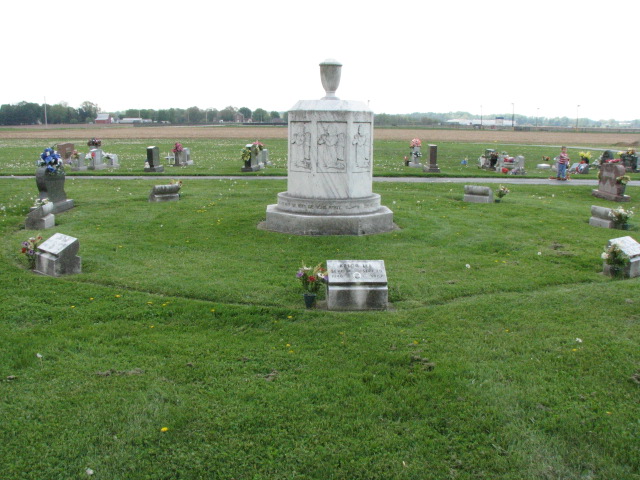
When I was a little girl, I often visited our local rural Cemetery in Washington, Michigan.

IMG_3535

As you can see from the Photo’s there are now house built all around it but when I was a girl it was surrounded by farm fields and 29 Mile Road was still a gravel road. You would see cows or sheep grazing with an occasional horse tossed in the mix. It was a peaceful place. I did not know anyone who was buried there but before long I knew them all.  It was an old pioneer cemetery and I was fascinated by it. I can still recall riding my bike down the gravel road as fast as I could. I would ride up the sloping entrance of the cemetery into the center of the graveyard, jumping off my bike and dropping it in the middle of the grass.

For the next 30 minutes or so I would wander the cemetery reading the names and dates on the gravestones. I knew that most years began with 18 instead of 19 so I knew they were really old. I was fascinated by them. In my childhood imagination, I would create thrilling stories about these people and their lives.

There was a Frost Family buried in the cemetery and I was sure that they could all write poetry like there famous relative, Robert Frost…

Frost

When I found a child, they would become my playmate. One day we might play marbles and the next it might be tag or hide and seek, hiding behind the tombstones…


A young woman would transform into a mother or a local farmer’s wife helping to milk cows, gathering eggs in her apron or hauling water to the kitchen…

SusannaStone-IMG_3483


When I saw a military stone, I would imagine soldiers in their uniforms marching off to war and fighting in battles.. This was long before I knew about the Civil War that the Northern boys were fighting the Southern boys…
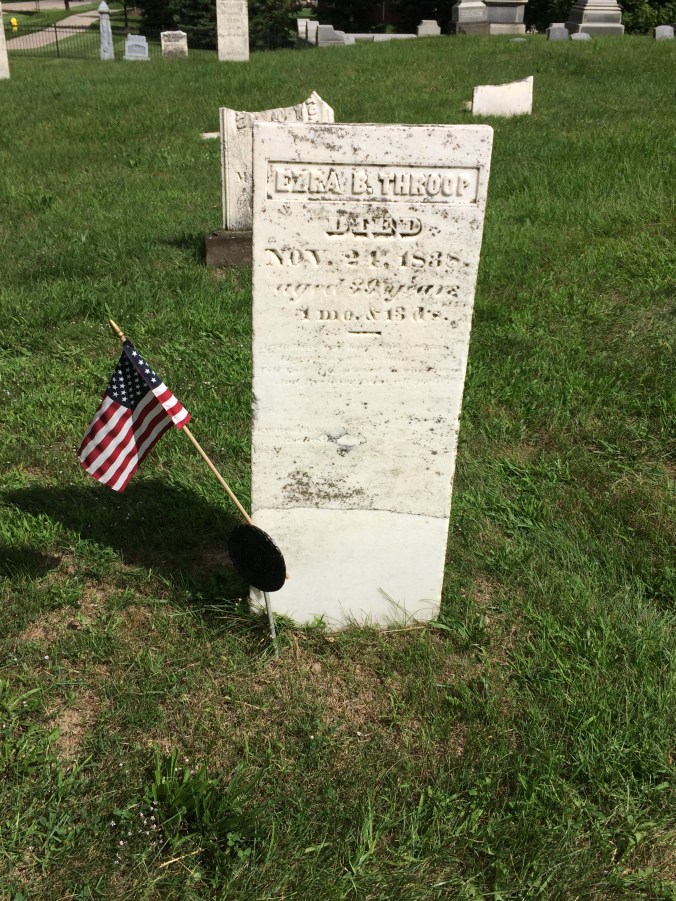
EzraBThroop-IMG_3532

Old men became like Grandpas letting you sit on their lap while they tell you about the old days, the really old days….

AaronStoneIMG_3486

Old woman became Grandmas that let you help make cookies or pies and a little mess once in a while…

MinervaWilson-IMG_3480


I wish I had written some of the stories down now, of course I was so young I was just learning how to write.  I came from a fairly large family and this was something I always did when I was alone.  It was not a conscious thing as I recall but in a large busy family each member needs some alone time and this was mine.

Some times it was fun to lie in the grass and watch the clouds as they formed, dissolved and reformed. I would see dogs chasing cats …or lions roaring or dolphins jumping as they formed from clouds which a few minutes later became a new shape that stimulates my young imagination. I would lay there with my friends who had been laying there long before me and have remained there long after I was gone…

When I retired and moved back to the Michigan, the state of my childhood, I visited my favorite cemetery.  It seemed smaller than I remember but still very special. I took photos of some of the tombstones. Some are old and hard to read.

Some people would think that this is all very strange  but there are very few places on earth that I like better than…….. a beautiful cemetery…

Happy Hunting,

Jan

#52Ancestorsin52Weeks

52 Ancestors in 52 Weeks – Week 18 – When there is a will…

“When there is a Will” is the phrase for this week which make me want to write about Mary Florence White Boyer.

Mary Florence White Boyer was my second Great Grandmother. She was the daughter of William C. White and Phoebe Johnson.  She was born on September 4, 1860 in Thetford Center, Michigan.  She married Austin Levi Boyer on October 14, 1882 in Clio, Michigan.

BoyerhouseClio2

Boyer Family – 1907

This is a Boyer Family Gathering which likely took place in the fall of 1907. I wish I knew what the gathering was but I do not.  It appears the be all the Boyer children of Valentine and his wife, Nancy (Leet) Boyer and their families.

I can pin point the approximate year for several reasons.  Austin Boyer is standing on the porch at the top of the stairs with his daughter Mae Eveleen.  Mary Florence is standing to the right of her husband on the porch.   Austin Boyer died on the farm of a heart attack on May 27, 1908.  Mae Eveleen is my Great Grandmother. She has three children at the time of this photo. She is holding her third son, Wallace(1907), my Grandmother Lillian(1905) is standing in front of her and Lester(1903) her oldest son is standing in front of Mae on the steps below her.

At the time of his death, Austin and Mary Florence, owned a florist and green houses where they grew flowers which they sold out of a truck.  What does a widow do when she loses her husband in 1908 and has two young sons, Glenn who was twelve and Austin Rex who was six….?  “When there is a will” ….there is a way.  For the first four years after Austin’s death, Mary Florence continued to run the florist. It is my belief that at this time that George Stephen and Mae E. (Boyer) Losee assisted Mary Florence with the green houses and the florist.

Tragically, Mae Eveleen Boyer Losee died in February 13, 1914 of what appeared to have been a heart attack.  This must have been another huge blow to Mary Florence.  She had lost a son, Henry in 1901, her husband in 1908 and her daughter in 1914.

Mae Eveleen and Stephen Losee had five children ;  Lester (1903), Lillian (1905), Wallace (1907), Mary Florence (1911), Ernest (1913).   Mary Florence sold the florist and the greenhouses. She moved to Flint where she bought a boarding house.  She lived in several places in Flint but in 1915, she is living at 1339 Orchard.  She has all of Mae’s youngest children living with her.  Lester is living with his father and they lived in Gladwin where George Stephen had bought a farm.

“Where there is a will ” … there surely is a way….

FlorenceEarnestRex@GmBoyers

Florence (Mary), Ernest and Austin Rex at Mary Florence’s Boarding house in Flint

By the 1920 Federal Census, Mae’s daughters, Lillian and Florence, are living full time with their Grandmother, Mary Florence. I have learned that this was very common for adolescent daughters of widowers to be raised by their Grandmothers.  Ernest lived for many years with Mary Florence  but by the 1920 Federal Census he was living with his father and his new wife, Pearl.  George and Pearl Delude married in 1918 when George  returned to Flint. He is working for the Auto Industry and it appears that Lester and his stepson, Gerald Delude are working there too.  A thirteen year old Wallace states that he is a Newsboy who delivers the daily newspapers while still attending school. (I thought it was awesome that he proudly stated that he was a “Newsboy” at thirteen.)

My Grandmother, Lillian,  would spend the rest of her adolescence living at Grandma Mary Florence’s Boarding house.  Lillian married Everett Smith on August 28,1923.  They had their first daughter, Lucile on October 29.1924.  Lillian and Everett had my father Harold Smith on August 30, 1928.

Mary Florence never learned to drive but she navigated the city of Flint by walking along the interurban train lines.  Lillian and Everett lived on Term Street in Burton, Michigan  and one of the interurban lines ran directly behind their neighborhood which Mary Florence used to visit her Granddaughter.  On the morning of September 8, 1928, Mary Florence set out to visit Lillian and Everett.  She would be meeting her newest Great Grandchild  Harold Smith for the first time.  Mary Florence was struck and killed by a train before arriving at her Granddaughter’s house.

For a woman in the early 1900 to remain independent after the death of her husband, is quite an achievement.  She ran a florist, greenhouses, boarding houses and raised grandchildren all alone.  That to me says ” When there is a will, there is a way!”.

Happy Hunting,

Jan

#52Ancestors

52 Ancestors in 52 Weeks – Week 16 – Air

52 Ancestors in 52 Weeks – Week 16 – Air

I am not sure why I have had so much trouble getting to this blog with all the Corona-virus time that I have on my hands. SO many things I can do…makes for paralysis ..I guess.

Today, I am going to write about Uncle Chuck. Uncle Chuck is the great uncle of my two sons. In other words, he was my first husband’s uncle.  My first husband and I were married for nearly 20 years so this family is still apart of me. They are still my family though I am not a blood sharing member of the family. The Kaake family members made me feel so much a part of their family and they still do today.

Charles A. Kaake Jr. was born on March 15, 1935 in Attica Township, Lapeer County, Michigan to Charles A. (Sr,.)and Rose (O’Malley) Kaake.  In the 1940 Federal Census, the Charles Kaake family lived in Almont. Eventually the family moved to Imlay City where Charles Jr. went to school through out his school years. Charles was pretty active through his high school years.  He was involved with the Journalism Club and Basketball Team. He graduated in 1953 and attended college in Michigan before entering into the Air Force where he graduated from the first class at the new Air Force Academy in 1959. During this time Charles met and married Lynetta Perry in Denver. He served his country being stationed in Georgia, Massachusetts and Hawaii. His civilian career began at LTV Corp before he became employed at Dana Corporation where he stayed until his retirement, eventually becoming Vice President and General Manager.

My introduction to Uncle Chuck came when his nephew, Gary, and I started dating while we were in high school. Uncle Chuck was the sweetest man… All of the Kaake men were and they made me feel like one of their own.

Uncle Chuck became interested in flying while in the Air Force though he was not a pilot.  At some point, Uncle Chuck took flying lessons and became a licensed pilot. By early 1970, Chuck and several friends decided purchase an airplane…A small Cessna. I can not remember whether they were living in Indiana or Tennessee then but he would sometimes fly from his home to an air strip in Lapeer for a quick visit to his Mother, Rose O’Malley Kaake, who lived alone in Imlay City. On more than one occasion I went to the air strip and picked him up and returned him later for his flight home.

On Mother’s Day in 1974 or 1975, Uncle Chuck came to visit his mother. I do not remember if I picked him up in Lapeer or if someone else did but I was visiting Grandma Kaake too, while he was there. Uncle Chuck and I were talking about his plane and flying. He told me that if I took him to the air strip in Lapeer when he was ready to go home, he would take me up in his plane. I was nineteen or twenty years old and had never flown before. I was over the moon with excitement.

When we arrived at the air strip, there sat the cutest little airplane I had ever seen. You see them flying in the air above you but they look totally different when you are standing on the ground next to it. It was a four “seater”. Chuck helped me up into the passenger seat, showed me how to put my seat belt on and began to go thru his check list. In front of me was a panoramic view of lots of dials, switches and a steering wheel type control device. Uncle Chuck seem to have many of the same controls in front of him. He explained that the plane could be controlled from either of the front seats. We put on some head phones.

“Are you ready?”, Chuck asked me and about that time the reality began to sink in….I am going to fly! We taxied around and got lined up on the runway. He gave it some gas and we were off, gaining speed as we traveled down the runway. It was exciting but it did not feel like the time we (a bunch of kids from school with Kevin Homer at the wheel)went 100 miles an hour on Attic Road. We were traveling fast but I was not afraid. (or was it my young adult lack of fear… we will never know) As we neared about the halfway mark on the runway he began to gently pulled back on the controls. In that moment as we lifted off the ground, I felt that first moment of floating, almost weightless. I was uncertain about what I was feeling and giggled nervously. Higher and higher into the air we went and my excitement grew to near exhilaration. I had never felt so excited in my life. To this day even in a large plane that brief moment still exists. That moment the tires are no longer on the ground and the wings begin to soar and lift you in the air, at that very moment, I think of Uncle Chuck!

We steadily rose over the trees and made a wide sweeping circle following Bowers Road as we headed east. Now I am full questions and amazement. I am seeing the very familiar terrain of my home town and its surrounding area from a much different vantage point. A vantage point that I had never witnessed before. I see Lake Pleasant from the air and the rural highway of M21 as it snakes to the east curving and swaying toward my home town. For the next hour or so, Uncle Chuck flew me around my home town pointing out my home, Dad’s store, Grandma Kaake’s house, the High School, Tietz’s Restaurant, the intersections of M21 and M53, the muck farms. It was totally amazing to see all these very familiar places from this very different vantage point!

We talked about the controls on the plane, the dials, the switches and what each one of them did. We talked about about how he navigated from his home in Indiana to Michigan by himself. I had to chuckle to myself when he told me he still followed the same road from there to here much as he would have in his car….but when the traffic backs up he get to keep right on going. Before long we had to head towards Lapeer to take me back to my car and he would have to head toward home. As we headed west, he asked me if I want to fly the plane….”ME? No, I don’t think so…I don’t know what to do…” “I’ll show you.” he told me.

SO for the next 15 or twenty minutes I flew the plane….Ok, I steered it, he told me how to keep it level. How to raise the nose and lower the nose and I forgot all about the scenery around me as I concentrated on the controls and the sky ahead of me. First we headed north for a little ways and made a wide fairly level bank as we headed west again toward Lapeer and the air strip. As we neared it, Uncle Chuck took control of the plane and we safely landed at the air strip. I got out of the plane with a huge smile on my face. Uncle Chuck got back in the plane and before long he took off again and headed home.

I stood on the airstrip watching him as the plane lifted off . My soul was soaring into the sky with him even though my feet were firmly planted on the grounds. It was a day that I will forever cherish.

Uncle Chuck died in 2006 while I was living in Illinois. It has been fun for me to relive this one-on-one experience that I had with him. He was a wonderful man! Do not ever under estimate the impact that you can have on another person by simply spending some time with them. This Kaake family did that for me…I have many stories of time spent with many members of this family which are precious memories.

Happy Hunting,

Jan

#52Ancestors


52 Ancestors in 52 Week – Week 15 – Fire

This week I am not writing about my family. So instead, I want to talk about a friend of mine who uncovered a heartbreaking story about the Colvin Family who lived near Columbus, Indiana.  My friend’s name is Mark Davis. We met many years ago in Crown Point, Indiana at one of his cemetery restoration projects. He runs seminars on the proper methods of cleaning and restoring tombstones. He has a company called Stone Saver Cemetery Restoration. He works and lives in Indiana. Mark gets hired usually by local townships or counties to go into an old neglected or damaged cemeteries and fix them.  He does amazing work.  He cleans tombstones and monuments. He fixes tombstones that are broken. He places tombstones back in there base and secures them. He adds the proper base to stones that need to be leveled and straightened.  Mark is an amazing guy!  He is a man of many talents and he loves a beautiful cemetery and so do I! 

While working on a job in early May of 2017, Mark found a family plot that was truly heartbreaking and he shared a little bit about it on Facebook.  I have shared this story on my Tombstone Tuesday Blog but I am going to share it here again today.

ColvinPlot

Colvin Family Plot

Knowing Mark, I am sure that it was this interesting family monument which first caught Marks attention.  And then, the story of this family touched his heart.

The Republic Newspaper – Columbus, Indiana – October 3, 1962

The Time for Tears was Past” The headline read as the newspaper story reported on the tragic lost of all six children in one family on September 29, 1962.

“The time for tears was past on Tuesday as nearly 100 mourners gather with the Walter Colvin family under an overcast sky at the Bethel cemetery at the burial rites for the couples six children”

“The youngsters were suffocated in a fire Saturday at their home near West Harrison on the Indiana- Ohio State line where they had lived about six months since moving from East Twenty-third Street. “ the article read. “The Colvin couple held hands as the Rev. Ivan Miller of the United Lutheran church spoke the final rites, but neither wept. Their faces showed the anguish now past tears”

“ A procession of 50 cars followed the five hearses from the Barkes and Inlow funeral home and continues the trip to the cemetery where pallbearers carried the light colored caskets with embroidered flowers from the hearses one by one.”

It is hard to imagine the heart ache that this couple endured. According to Julia Terry, a Facebook friend of Mark’s, Barry, the oldest child found the fire and woke his mother, Mina Jo, who ran to the neighbors to get help. Barry remained in the house to tried to get the rest of the children out. By the time Mina Jo returned to the burning house it was too late and all the children were caught in the fire. Walter Albert, the father, was a truck driver who was on the road at the time of the fire.  Such a horrific family tragedy

Mina Jo Rice Colvin was born in Danville, Illinos on July 4, 1926.  She married Walter Albert Colvin on November 7, 1953.  She died on June 25, 1998 at her home.

Walter married Linda Grimes who also preceded him in death. She died in 1999. Walter was born on August 5, 1927. He was the son of Clifford and June Hansen Colvin. He was born in Paris, Illinois on August 5, 1927. Walter was a veteran for the Air Force in WWII. He was a member of the American Legion and the Veteran of Foreign Wars. He was a truck driver for Stone Container. He died on February, 17, 2009 in Columbus, Indiana.

Sometimes in our research we find tragic stories  and they just need to be remembered.  God Bless this whole family on this strange Easter Morning while we are all “sheltering in place ” due to Covid 19.

Have a blessed Easter.  He has risen!  He has Risen indeed!

Love, Jan


52 Ancestors in 52 Weeks – Week 14 – Water

HansAnderson1880-2

Hans Andersen – 1880

The 52 Ancestors in 52 Weeks word for Week 14 is Water.   What that brings to mind for me is my Norwegian Family and the long line of sailors that we have. My Grandfather came to America in 1904. He was a sailor and the son of a sailor, Hans Andersen,  who was the son of a sailor, who was the son of a sailor, who was the son of a sailor…..and so it goes.

I have been fortunate enough to locate and become friends with my Step-Great Grandmother Mathilde’s Great Niece, Inger Zeiner. (Yes I know that is a mouth full, think about that for a minute or two.)  Inger has helped me with a lot of my Norwegian research. She is active in the Tjome Historical Society now that she has retired and returned to Tjome to live. She has provided me with a sailing history for Hans complied by a friend and local historian, Lars Endresen. It is not known what year Hans retired for sure so this may not be a complete listing but this is what Lars found through his years of local research.

Hans Andersen sailed all over the world and including at least seven trips to America. His early sailing days started in March of 1880 with a trip to America.

Date Embarked    Ship Name    From          To            Date Returned         Where

03.31.1880             Rebekka        Svelvig     Amerika      09.23.1880        Drammen

10.13.1880          Vashington    Tønsberg   Hamburg     11.23.1880        Tønsberg

04.16.1881             Solo              Tønsberg    Amerika     12.14.1881        Tønsberg

03.30.1882             Salo              Tønsberg    Amerika     11.24.1882      Shipwrecked

02.06.1883       Thorsbjerg        Tønsberg    England      01.14.1884       Tønsberg

03.31.1884     Harbels Anker    Tønsberg   Horjefjord   08.21.1884      Tønsberg

03.25.1885            Nina              Tønsberg    Amerika     04.??.1887       Liverpool

06.28.1887        Gorilla        Fredrikshald     England     12.06.1887       Tønsberg

04.13.1888        Norway           Sandefjord     Amerika

03.04.1889        Norway          Sandefjord      Amerika

06.08.1889       Lillesand         C.J.Værn          Orlogs         07.09.1889     C.J.Værn (Navy harbour in Horten)

07.22.1889       Winnipeg         Tønsberg          London

01.28.1891       Entreforce       Tønsberg          Cardiff

06.23.1893       Berthe Rød      Tønsberg          abroad           02.12.1894       Tønsberg

05.04.1894       Lawrense        Tønsberg          abroad           02.06.1895        Greonck

03.21.1895       Lawrense        Tønsberg          England         08.20.1895        Tjømø

03.28.1896      Lawrence        Tønsberg         America          02.18.1897      Tjømø

04.06.1898      Familien          Chri(sti)ania     abroad           11.03.1898 Chi(sti)ania (Oslo)

04.13.1899      Høvding           Moss                 abroad            12.02.1899         Moss

The Lawrence is the Sir John Lawrence registered out of London but sailed out of Tonsberg.

IngeborgHelene1890-2

Ingeborg – 1890

My great grandmother, Ingeborg, died of TB on Sept 18, 1894. My grandfather, Andres, was eight years old. He had two brothers, Jacob Hagbart and Haakon who were six years old and three years old at the time.  Notice that on the listing above. Hans had left on the ship the Sir John Lawrence out of Tonsberg on May 04, 1894 and did not return until February 06, 1895. Hans did not know of his wife’s death until he returned in February. Hans’ mother, Olava Jorgensen, the boy’s grandmother, cared for the boys until he returned.  Within a year he had married, Mathilde Zeiner. My mother told me that her father spoke fondly of his step-mother but did not call her Mother.  She said that he told her, “ She took good care of us but she was just not my mother. “ For young Haakon, the three year old, he never knew his birth Mother, he had no memory of her.

HansHenrikAndersen

Hans and Mathilde Andersen

It is said that old sailors become fisherman when they retire and according to Inger, Hans did that but he took it one step further.  He bought a sailboat and started a small charter company which would give tourists from Olso sailboat tour in the Olso Fjord or a fishing trip. When Hans did not have a scheduled chartered  tour, then he fished and sold his catch to local markets.

So for my Norwegian family, they were truly focused on water!

Happy Hunting,

Jan

#52Ancestorsin52Weeks
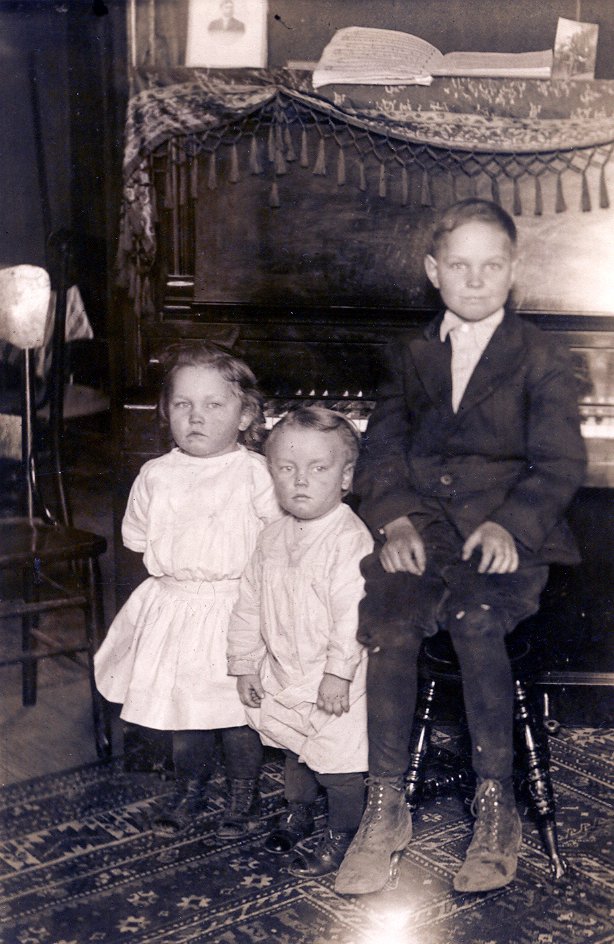
 

52 Ancestors in 52 Days – Nearly Forgotten

Susanna M Smith was the eleventh child born to James and Susannah (Overly) Smith. She was born on December 25, 1852 in Nine Mile, Indiana. She was the younger sister of my 2 times Great Grandfather James W Smith who was nine years older than Susan. Susan married Henry Rehnen on June 20, 1872 in Fort Wayne, Indiana. They had five children; Katherine M, Edward Bernard, Francis, Elnora, Rebecca.

So by now you must be thinking that, how could Susan (as she was known) be nearly forgotten? Well, let me tell you.

Oella-Sister001

It all started with this picture. It is not one of the pictures that I wrote on for my Grandmother that summer day with all the other pictures.  She obviously continued to try to sort this out well after our picnic. This one she wrote on and it said “Della and her sister.” For the first few years of my research, the woman with the scowl was called Della because that is what Grandma said her name was. I later learned that she was sometime called Ella, Celia, Della and Oella depending upon the census or the record that you looked at. Grandma did not know her, she was her husband, Everett’s, Grandmother. My Grandmother knew that she was James W Smith’s wife but that was all she knew. I think that Grandma assumed her name was Della because she named her daughter Della. In due time I determined she was Oella Denney. I contacted all the Denney family member I could find in an attempt to find out which of Oella’s three sisters this could be in this picture. Each person responded that they did not know her. They said she is not a Denney.

The more I looked at this photo of Oella and her sister, I decided that the Denney family members were right, these two woman were not sisters. They did not look at all alike. I know that all sisters do not look alike but there are always some similarities and these two had none. Oella had a permanent scowl but the other woman had a bright face, maybe she is squinting but what I see is a smile! How could the lady with the scowl and the lady with the smile be sisters…. In my mind it just could not be. Yet this woman was very much apart of the lives of these relatives of mine. This picture is from a family baptism. It is Loydell Malone’s baptism. He is the Great Grandson of Oella Denney Smith and he was born in 1923.

DoraLoydellRuthOella020

Notice that Oella has the same dress on as in the previous picture. This picture is a four generation photo of Loydell Malone on the lap of his grandmother, Dora Jackson, with her daughter, Ruth Jackson Malone, standing and Oella seated next to her daughter, Dora. This photo was correctly identified, except of course that Oella is called Della. And it clearly stated that this was Loydell’s Baptism. So this told me that once again the smiling woman was invited to family gathering.

She frequented all the Smith Family gatherings it seemed even long after James died in 1913 and Oella died in 1925. In this photo she is seated between Dora Smith Jackson and Della Smith Sparks in the middle of the photo. All of the other family members are Jackson or Sparks family members. I do not know what this family event was but on the back it said “Fort Wayne Smiths

FtWayneSmith

So who is she? SO I kept looking at her and wondering where she belonged.

I would find clues and not really realize that they were clues. When I found the death record for James’s brother, Joseph, in Chicago, I would get a burial date in Fort Wayne. With that I found an Obit who mentioned a surviving sister, Mrs. Ralhman. I could not find a Ralhman in Fort Wayne. For years I searched for Rahlman, Ralhmen, Ralman, Rehlman, Relman and every version I could think of but no one was found. James and Joseph did have several sisters. All of the sisters which were older than them, had died long ago. They had two sisters who were younger, Susan and Martha. One of these woman must have been Mrs Ralhman I thought. As I continued my search, I found Martha. She had married Henry Hauss and settle in the neighboring county of Huntington where she would die at the age of 21, in 1877. So it is not her. It had to be the sister, Susan, but why can’t I find her.

So I started to search for a woman born between the years of 1850 and 1853 whose first name was Susan or Susanna. Eventually I would add the criteria of a surname (married name) beginning with “r”. After a few weeks of searching, there she was Susanah Rehnen. Could this be her? It would take some time but eventually I would obtain Obits for Susanna, her son Bernard, his son Parnell and Parnell’s son, James who died in Larkspur California in 1994. Eventually I did a search on a website called anywho.com and much to my surprise there was a B. Rehnen who was listed in Larkspur, California. As I recall, this was around 2003. I have used this tool several other time successfully to find children who are still living who had been listed in their parent’s obits. Usually I write down the name, address and phone with a note about who I think they are and how I suspect they are related to me. After finding several, I would write a generic note explaining who I am and that I am looking to confirm information and provide them with information on how they can contact me. Sometimes they do get back to me and sometimes they do not. Not everyone is as interested in their families past as I am.

I had been looking at this photo and getting to know this woman for so many years and I just had to know who she was. She was another lost relative who spoke to me every time I looked at her just begging me to find her. This process of elimination had been so slow that I took a bold step. I picked up the phone one Sunday afternoon and I called the number. A sweet elderly woman answered the phone. I explained to her who I was and how I thought I was related and she quietly listened. Eventually she broke her silence and said, well you know, you are not actually related to me, it was my husband that you were related to and he has been dead for some time. Then she went on to tell me that his sister still lives in the Fort Wayne area and that I should call her. Susan Katherine Brown is her name.

After talking to Susan Brown, I was able to identify this sweet woman as Susanna M (Smith) Rehnen (pronounced Wren like the bird…as she explained), Susan Brown’s Great, Great Grandmother. Susan is named after her. Susan would supply me with several other wonderful photos’ of Aunt Susan and I was able to supply her with a few that she had never seen.

It would be a day that I would solve another one of the “needles in my haystack”. The clue on the photo would have helped if it had said “James W. Smith’s sister, Susan”. She was Oella’s sister-in-law not her sister but as I think of it, that would have made it too easy and I would not have learned so much about this part of my “Haystack”! I thought it was amusing when I received this photo from Susan Brown, there is the Oella scowl and all…

Oella&Sister019

So maybe this post should be about a misprint or a wrong relationship. I have had to solve several of these because my Grandmother was valiantly trying to help me understand who my Grandfather’s family was when he was not really interested in the project. She only knew his family from the current generation not any of them who came before.

SusannahSmithRehnen001

So meet Susanna M Smith Rehnen. May she never be forgotten.

Love, Jan

#52Ancestors

52 Ancestors in 52 Weeks – Week 12 – Popular

Harold011

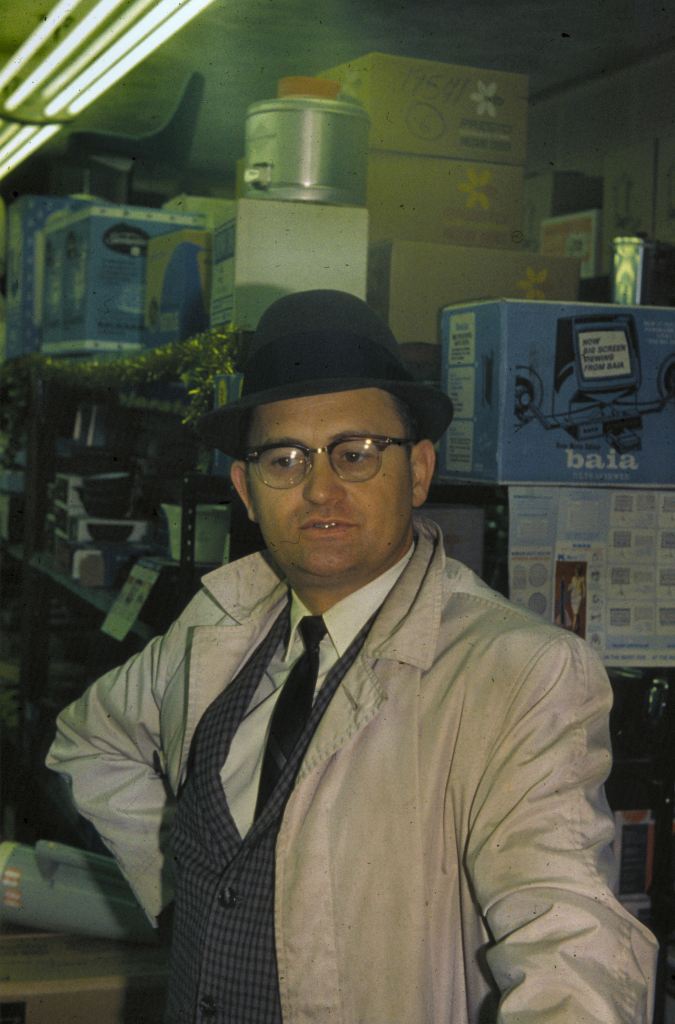
My father was Harold Smith. He was born on August 29, 1928.  He was the son of Everett and Lillian (Losee) Smith. Everett was a Methodist Minister  who was ordained in 1932 when Harold was three years old. They moved frequently as many ministers did. Everett’s first church was in Flint, Michigan. His second church was in Genesee, Michigan and at that time he also covered the Richfield Center Church too. His third church was eighty miles east southeast of Genesee in Marine City, Michigan. After Marine City, they would go to Lapeer where Everett would complete his work in the old downtown church and then retiring from Trinity Methodist after it was built.

HaroldASmith1938003

Harold -1937

Harold moved frequently as a child and with each move came new schools and friends. Making friends came easy for Harold. He was a joker, a prankster and always ready for a good laugh sometimes at your expense but just as often at his own expense. He was very involved with his schools and his churches.

VBS-GeneseeVacationBibleSchool1939

Vacation Bible School at the Genesee Church – 1939

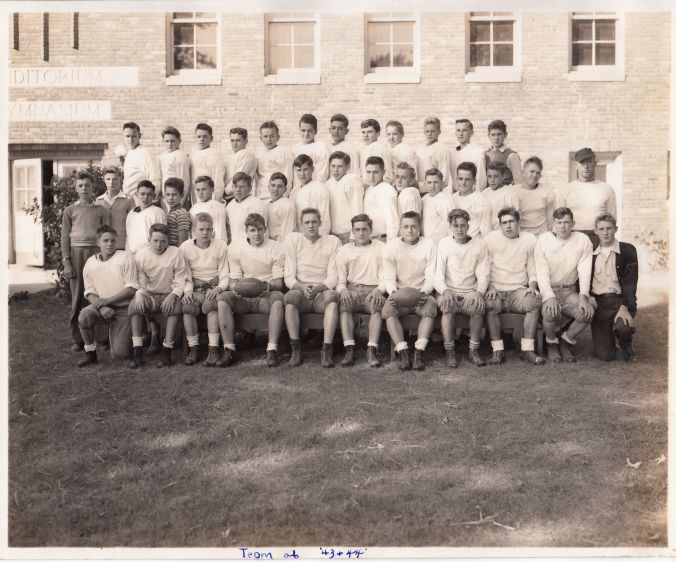
When they moved to Marine City in 1943, Harold was fourteen and beginning High School. He became interested in sports.  He played football in the 1943-1947 seasons and ran on the track team for the same years.

MCFootball-1943-1944

Marine City Football 1943-1944

In 1945 season for track, he ran barefoot. I am sure that his mother was mortified because she always told us a story about how she cut her foot badly on a tin can and that we should never go barefoot….

MCTrackTeam-1945

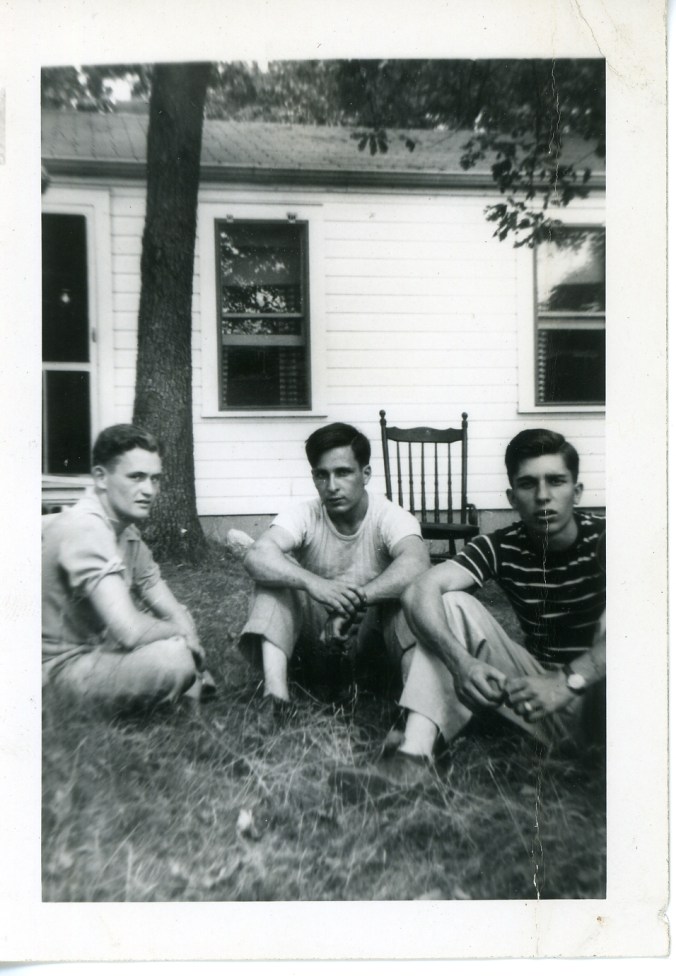
He had a large circle of friends from church and school. This picture is of him and his friends at the cottage at Skinner Lake near Lapeer.

Haroldand Friends atthecottage1946-004

He met his future wife, Leah Anderson, when they lived in Marine City.  Not only did they go to school together but they attended the same church.

HaroldLeahGraduation-1946

As a young adult he went to St. Clair Community collage for his Associates Degree and later to Mott Community College in Flint to get his Bachelors degree. While going to college, he worked for JC Penney’s in Lapeer.  It became really obvious that retail was the perfect line of work for him. He loved people and he connected with everyone at every age.

Harold Smith 1950

After graduation, Harold first went to work for Egleston’s in Lapeer and before too long he moved to the store in Romeo. We moved to Romeo shortly after I was born in August of 1955. Bill Mitzelfeld married Diana, one of the Egleston daughters and worked in the family business for a time before deciding to open his own store, Mitzelfeld’s in Rochester.  Harold decided to follow Bill to the new store.

While living in Romeo, Harold was very active in the Romeo United Methodist Church where he had many wonderful friends. Our childhood was full of church events every week. Often the fathers took the older children to the church activities while the Moms stayed home with the younger kids in the family.  Dad became good friends with all of the men at our church who were actively involved in their older children’s activities. Through the years we went on camping trips, canoe trips, hayrides, to Fisher Theater to see the release of the movie “The Ten Commandments” and Sunday afternoons trips to the pool at Oakland University. Most of these events were planned by and coordinated  by my father and his friends at the Romeo United Methodist church.

HaroldSmith1-1967

Harold Smith -1967

In 1971, Bill Knight, a close family friend, decided to retire, and Harold bought the Ben Franklin store in Imlay City. We had move to Imlay City in 1968.  He was active in Rotary, Imlay City Chamber of Commerce and the Imlay City United Methodist church. In all of these organizations he was a very active member. It was obvious that he was really in his element.

In the Imlay City store, he had a well stocked bulk candy counter and a peanut/nut roaster. My father LOVED Spanish peanuts! When he fired up the nut roaster, the people would flock into the store. When the weather was good he would throw open the doors and the roasted nut aroma would flood into the streets of downtown Imlay City.

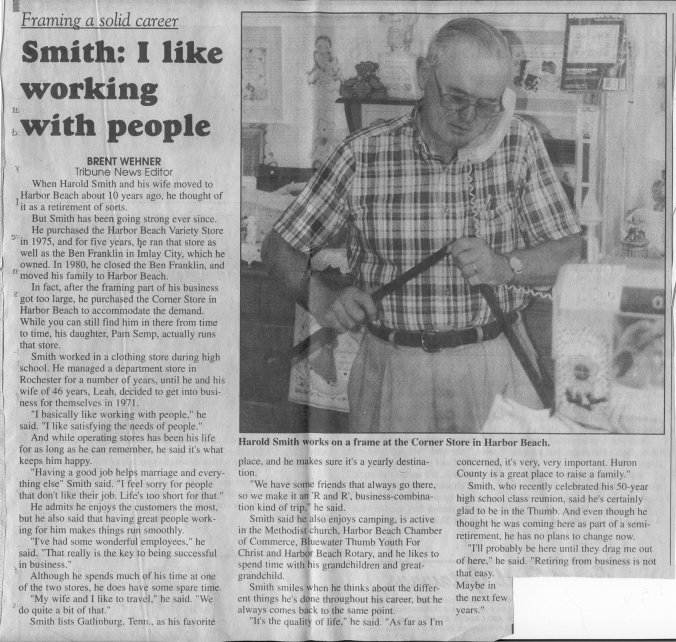
Through the years there were several articles written in the local newspapers about  him and the type of character he was. The Lapeer County Press once featured him in their “Good Guy” column. In the article, a customer called the newspaper to nominate him for the Good Guy reward after he help her daughter out. Her daughter had saved her own money to buy a pair a shoes. She bought them and after a short period of time one of the shoes developed a hole.  So they brought the shoes back to Harold. He took one look at that shoe and retrieved another pair of shoes for her in her size. He told the little girl to keep the other shoes and use them for play.

hasmith-newsart2

In the 1975, he bought the Ben Franklin in Harbor Beach and ran both stores for a time. Once all of his children had completed high school in Imlay City, Harold and Leah closed the  Imlay City store and moved permanently up to Harbor Beach in 1980. His plans was to semi- retire but he jumped into the community and his days looked nothing like retirement.

HaroldLeah

Harbor Beach Store and the Candy Counter

hasmith-newsart

For the next sixteen years Harold and Leah actively ran the Harbor Beach Dime store. As the article states, Harold had a great bunch of employees, one of whom was my older sister, Pam. He always carried fabric and sewing notions for me! (and all of his other customers) He had encouraged me when I was eight years old to learn to sew. “If you learn to sew, I promise I’ll always have fabric for you! “, he told a crying eight year old after he had to tell me that he could not afford to buy me the Easter dress I wanted.  It was not in his budget.  I did learn to sew and so did my sisters.  He kept his promise. He always carried fabric and notions for us until the day he died.  He expanded his business to offer framing services that would help draw business in the winter months.  Since Harbor Beach was a bit of a tourist town with lots of extra summer visitors,  he always had souvenirs, tee shirts, sweatshirts, and sunglasses. No one could predict when the wind would shifted, turning cold off the lake or the sun would be blazing and you needed to keep it out of your eyes but he was bound and determined to have you covered no matter what.

The last line of the article is rather poignant. My father died suddenly on the morning of August 30, 1996 in my parent’s apartment in the back of the Harbor Beach Store. He was taken out of the store on a stretcher that day for the last time.

A few days later, the church as packed for his funeral with all his friends. I was, at that time, not very comfortable speaking in front of a crowd of people but that day I did, thru my tears. I told the crowd that I had been asking myself, WHY? Why couldn’t he get a second chance? Why don’t I get to talk to him again? Doesn’t MY father deserve a second chance at life. My husband was a paramedic in out town of Fox River Grove, Illinois. He had revived many people who had suffered a heart attack. The medical community had made many strides so why had my father not benefited from all these advancements. After several days of contemplation, I decided that God did not need to give him a second chance, because he lived his life right the first time. He was a friend to all.

So he was indeed the most popular man I have ever known.

Love you and miss you, Dad!

Jan

#52Ancestors

52 Ancestors in 52 Weeks – Week 11- Lucky

*********************************************

LUCKY – Webster’s definition of “lucky” is :

having good luck,

happening by chance : fortuitous

producing or resulting in good by chance, favorable

seeming to bring good luck

***************************************************

In my family history journey, photos have played an huge role in my search. They have been an important resource. Many times all I had was a single photo and it was my only lead.

Etta C Smith Wert

Etta Clare Wert

This lovely photo was one of my first lucky photos. It is of Etta Clare Wert. That was what was written on the back of the photo.  Written in my handwriting all those years ago.

HOMER WERT

Homer Wert – 1903

This is a photo of Homer Wert. I knew these two people were probably married. I knew they were probably related to me but I had no idea how.

These photos were a part of those photos that my Grandmother left for me to find. They were the photos that we worked so hard on at the picnic table in Imlay City. We spent the afternoon flash card style showing them to my Grandfather so he could tell us who they were. I wrote about that day in my “Favorite Photo” blog earlier this year. I was the scribe that day. I wrote on the back of the photo in my thirteen year old handwriting because Grandma said that my handwriting was better than hers. I spelled the last names the way I heard them. I did not know these people. I did not care to know them.  I was in a hurry to go be with my friends. Thirty years later, it shocked me to see my handwriting on the back of these photos. Grandma and Grandpa were long gone and so was my Dad.  I had little or no recollection of that day until I looked at the first photo and saw my handwriting.

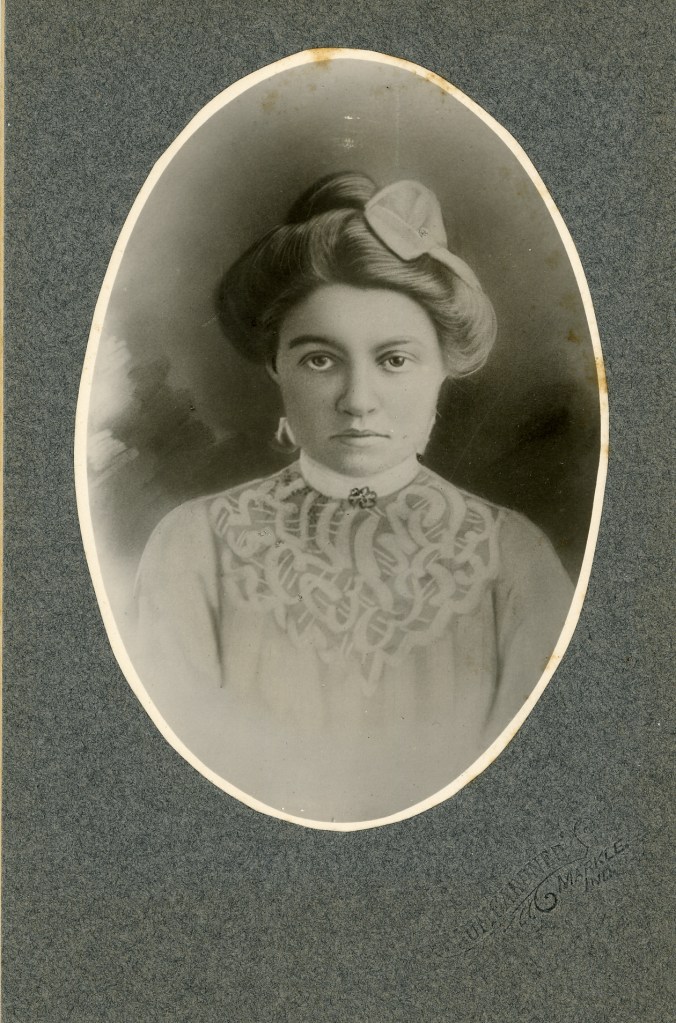
I am writing about Etta Clare today because I am “lucky” to have found her. She got lost in time. She was born in 1882 well after the 1880 Federal Census was taken. In that Federal Census, there were four children listed in the James W and Oella Smith household; William, Alvin, Della and Dora. Then, of course, there is no 1890 Federal Census to look at because it was destroyed in a fire at the Archive in Washington DC.  I thought for the first few years of my researchers that James and Oella Smith had five children; William, Alvin, Della, Dora and Frank (Francis). I had plenty of family photos and supporting information to confirm these people. I did not find the family in the 1900 Federal Census early on in my research.

Oella’s name was often misspelled because it was unusual and since I had no family Bible to work from I “assumed” the information that I had was complete and correct. This was pretty early in my research and Ancestry had much less data to work with than.

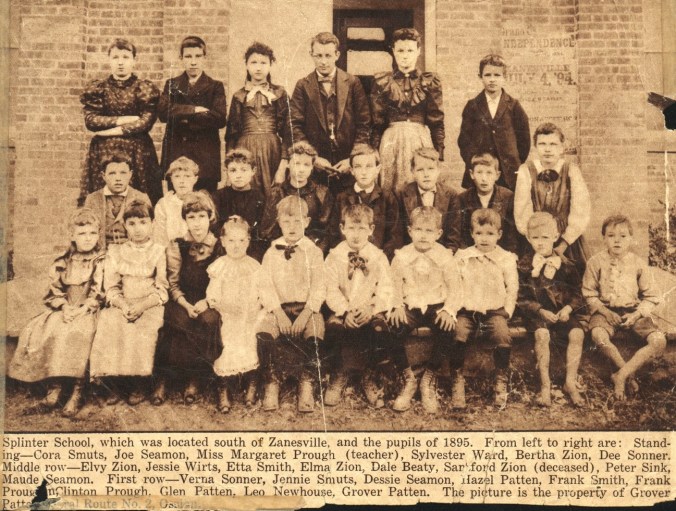
In those early days, I used the USGenWeb.com website a lot. Unfortunately the pages are not always maintained today but I still used it as a resource. SO when I found this photo of the 1895 Splinter School  posted on the Wells County site, I took a good look at it. There were a several family names that I recognized. The photo was originally owned by Grover Patten. Grove Patten married my cousin, Nora Sparks in 1912. Nora was the daughter of Della Smith and her husband, William Sparks. So that was the first name I recognized. Then I saw Frank Smith and realized that this was my 2nd Great Uncle Francis Smith. Uncle Frank, whom my Grandfather often fondly talked about!

SplinterSchool1895sm

Splinter School Photo – Zanesville, Indiana 1895

As I continued to read through the names, I saw Etta Smith. I looked at the face and all of a sudden I realized that I had seen that face and that name before! Where had I seen that? I went to my pictures and there she was. Etta Clare Wert but first she was Etta Clare Smith!!??! I found you! The goosebumps consumed me and I choked back tears. ” I know who you are, Etta! ”  I told her! My physical reaction even today is the same.  As I write this I get goosebumps! Sure enough, James W and Oella had a sixth child and her name was Etta Clare. She was born on October 26, 1882. In this photo she was thirteen years old.

In 1903, at the age of twenty one, she married Homer Wert. The photos that I have are their wedding photos.  They had a son whose name was James Frank Wert. I have a photo of him too. He was born in 1903. In 1905, Etta Clare tragically died during child birth on July 11th. at the age of twenty three.  Her daughter was delivered alive and Homer named her Lulu Etta Wert.  Etta Clare was in one census, the 1900 Federal Census and in one Marriage record that was not available when I began my research. She was nearly invisible due to her short twenty three year life.

James W Smith FamilyCP

James W Smith Family – 1910

In this Smith family photo take around 1910, the two children seated in the front row on the left are Etta and Homer’s children. James Frank and Lulu Etta. Standing in the back row fourth from the right is Homer Wert.  After Etta died, Homer took his children and went to live with his parents. These small children were raised by his mother. They lived near Uniondale, Indiana. In June of 1909, Homer married Allie Fergunson.  Allie died in 1912, a short three years later, of Tuberculous. In 1919, Homer married Josephine Potee. She and Homer had two daughters; Margaret and Mary.

In my family information I had very little evidence of this family. Only Etta and Homer’s wedding photos and a photo of James Frank when he was a few months old. This family photo above, I received from a cousin a few years ago and after I solved the Etta Clare mystery.

BuckeyeSchool

This is a photo of the Buckeye School from 1915 in Wells County, Indiana. The fifth child from the left standing in the back row is , a ten year old, Lulu Etta Wert. (with the braid over her shoulder) and her brother is second from the left kneeling in the second row, Frank Wert. This school was in or near Uniondale, Indiana because I have other family members in this photo that I know lived in Uniondale.  They were the Meeks children, Velma (who is standing next to the boy who is behind Lulu) and Paul ( first boy seated on the left in the front row).  It was these Meeks children that drew my attention to this photo. And I had not expected to find the Wert children.

So these photos have been the key to my “luck” in discovering this family.

Happy Hunting,

Jan

%52ancestorsin52weeks

52 Ancestor in 52 Weeks – Week 10 – Strong Woman


AddieOlgaCropped

Addie and Olga -1911

This week I am going to write about my grandmother, Addie Densmore Anderson.  We  never got to met because she died four months before I was born of breast cancer. Addie was the oldest daughter of Charles Densmore and Mary Morgan Hayner. They had eleven children and Addie was the oldest child. She was born in Cottrollville Township, Michigan on October 12, 1890.

As a young woman of 17 years old, Addie was working on a milk delivery wagon and delivered milk to the Gustav Englehart home. It was there that she met handsome Norwegian sailor who was a rented a room from Gus and his wife.  She quickly fell in love with him.  And soon after, she married Andrew on December 9, 1907 in Windsor, Ontario. The marriage record states that she was nineteen but all my other records indicate that she was seventeen.

After she married Andrew, she took a job as a cook on the ship where he was working. Being a cook on a ship in the middle of the Great Lakes took real courage. At that tender age, all she could think of was your new husband and the life you are building together. I married at a young age too, so I can relate to her decision and likely would have done the same but thinking about it today at my age, it scares the dickens out of me. That first winter, Addie and Andrew were held up aboard their ship in the Chicago Harbor. They were “keeping ship” as they called it. Andrew had his daily jobs that he performed to ensure their were no problems with the ship or it’s mechanical systems. The ship had a skeleton crew of a few ship hands whom Addie cooked for . What a way for newlyweds to spend the first few months of their marriage. My mother, Leah, stated that her Mother spoke very fondly of those early days of their marriage. They had time to explore Chicago and learn about each other. Addie would need to go to the market to get food and supplies regularly, so she could cook meals. Being from the small village of in Michigan, Chicago must have been exciting in 1907. For 20 years from 1994 until 2014, I lived in Fox River Grove, Illinois, a suburb of Chicago and we often visited downtown.  I can’t quite image what the city must have been like in 1907. The newlyweds had their first photo taken in a Nemecek Photography Studio at 602 West 18th Street in Chicago, Illinois.

AddieAndrewWedding2

When Andrew and Addie were not at sea, they lived with Addie’s parents in Marine City, Michigan. They were recorded with her parents in the 1910 Federal Census. On October 27, 1911, Andrew and Addie had their first child, a daughter, who they named Olga. At some point before the birth of her daughter, Addie returned to Marine City where she and Andrew settled. Andrew continued to sail the Great Lakes on several different lake steamers; SS Geo King, SS Wm Eldenborn, SS Walter Scranton

AndyAndersonCrew-edit

Andrew is standing directly behind the life ring. This is the Captain and crew of the steamer Walter Scranton

On November 7, 1913, an extremely violent late fall storm developed over the Great Lakes and lasted for several days. This storm was much like “The Perfect Storm“ depicted in the movie that was released in 2000. Even though the Great Lakes are not as big as an ocean but they have the ability to create atmospheric conditions which rival ocean created storms. This storm is often referred to as the “White Hurricane”.  No other storm of this magnitude in recorded history had ever struck the Great Lakes. Lake Huron was especially hard hit but there was wide spread impact on all of the Great Lakes from this storm. It was a classic nor’easter which dumped several feet of early snow on most of Michigan and especially large amounts along the shoreline communities. Waves were recorded between 30 and 40 feet on the lakes.  It took over 250 lives with the wreck of 40 ships, 8 of which were large Lake Freighters which sank to the bottom of Lake Huron. I have not been able to determine whether Andrew was on the Lakes during this storm. The Marine Freight Season would have two months more of shipping before it closed in mid January. It would seem logical that freight companies which were nearing the end of their shipping season would be trying to get as many runs in as possible before the close of the season. If he was at sea, Addie must have been extremely afraid for her husband. Since she had sailed with him for a couple of years, she must  have experienced several storms during that time.

Eventually Andrew would stop sailing. In his 1918 WWI draft registration, he states that  he is working for an electric street car company which ran between Port Huron and Detroit. William Edison and his brother Thomas created the first electric street cars system in America. It was installed in Port Huron about twenty miles from where Addie and Andrew lived. These street cars were eventually extended from Port Huron to Detroit as noted in Andrew’s Draft registration.  Street cars enabled workers to commute from Port Huron to Detroit for work. Andrew became employed in the electrical substation which powered these electric streets cars.  I have wonder just how much the “White Hurricane” contributed to  Andrew’s decision to find employment on dry land.

In the years to come Addie would have eight children, six boys and two girls. In order to feed her growing brood, she and Andrew grew a large garden which became a family affair. Much of the Densmore families members including her parents, siblings and all the children worked in the garden through the growing season and they all canned and preserved what they grew. This garden was how they survived the lean years including the depression.

AddieAndrewGarden001

Addie, Andrew and her family in the potato patch.

AddieandChildren-crp001

Addie learned to drive when they bought their first car. Most women did not at the time. She was involved with the local Woman Suffrage movement working toward women rights to vote. She was thrilled when she could finally vote and exercised that right faithfully and encouraged other women to vote as well. She was known to sometimes sit down with her friends and enjoy a pint and smoke a corn cob pipe on a summer day. She was very dedicated to her husband and her children taking the utmost care to raise them.

AndersonFamily1938006

Back Row: Robert Wesley, Andrew Fredrick, Ray Densmore, Charles Henry
Front Row: Addie Densmore Anderson, John Hayner, Andrew Anderson, Leah Mae, Olga Marie, Herbert William

All four of her oldest sons served in WWII. Ray Densmore served in the Army and mustered out of Fort Custer, Michigan. He worked in the supply chain. His company chased Rommel’s forces across Northern Africa from battle to battle. Robert Wesley and Andrew Fredrick served in the Merchant Marines. Robert mustered out of Connecticut but I have not found where Andy mustered out of. Robert Wesley and Andy shuttled troops, supplies and munitions across the ocean to the closest ports to the front lines. Andy ended up being deployed on the Russian front at the end of the war. It was during the war that the three oldest sons became interested in motorcycle.  An interest which lasted throughout their adult lives sometimes to the chagrin of Addie. Charles Henry (Moon as we knew him) was in the Navy and mustered out of the Great Lake Navel station in Chicago. Charles Henry was deployed in the Pacific fleet. Addie had to be strong to support her family and her sons as they fought for their country.

My mother was the youngest daughter and third youngest child. She was a gentle,quiet girl living a in a houseful of loud boisterous young men and boys. When my mother started dating my father, the Methodist preacher ‘s son, Addie sat down her older boys and warned them to behave themselves! “Please do not spoil this for Leah!” She warned them. And they must have behaved because Leah married the preachers boy on May 27, 1950.

EverettLillianLeahHaroldAddieAndrew-May27-1950-bw5X7

Rev. Everett Smith, Lillian Losee Smith, Harold Smith, Leah Mae Anderson Smith, Addie Densmore Anderson, Andrew Anderson. – May 27, 1950.

Addie was diagnosed with breast cancer in the fall of 1954. It had spread and she had likely had it for sometime. There was little that they could do to treat it at the time and she died in April of 1955, four months before I was born.

Though I never met her, I feel an intense connection to my Grandmother, Addie. I am an avid gardener, as she was. I have been a trailblazer of sorts through my life, as she was. I did not follow all the “normal” social rules and neither did she. I have bucked the system, so did she. I am a quilter and so was she! I am intensely connected to family today and my ancestors from my past, and so was she.

She was a strong woman and so am I.  I love you Addie!!!

Your granddaughter, Jan

#52Ancestors

52 Ancestors in 52 weeks – Week 9 – Disaster

The Wild Fires in 1871 in Michigan

October 8, 1871 was a horrific day for the mid-western states of Michigan, Wisconsin and Illinois. After an extremely dry summer in 1871, a wildfire driven by high winds erupted in Peshtigo, Wisconsin, killing 1300 people in one evening and burning over 1,100,000 acres in Wisconsin and the Upper Peninsula of Michigan before it burned itself out. The same night the famous Great Chicago Fire erupted which burned three square miles of the City of Chicago., killing about 300 people and leaving over 100,000 people homeless. And on the very same evening in the lower peninsula of Michigan, another wildfire began it’s race across the state from Lake Michigan to Lake Huron.

In the 1830’s logging was a significant industry in Michigan. There were sixteen large sawmill operations running in the state by the mid 1850’s and the area known as the “thumb” was in the midst of a logging boom.   They were logging White Pine tree which were 150 feet tall and 5 foot in diameter. This type of operation left behind branches, bark and other wood material known as slash which became fuel for fires.

Often they would use small fires to burn stumps and slash.  These slash fires were started by farmers or loggers and often were left simmering for weeks as the stumps of the trees burned. It was these types of fires which flared up and explosively ignited when atmospheric conditions were exactly correct to brew a wildfire. A hot wave of gale force wind came roaring up from the southwest reaching speeds of a tornado. It was a gigantic blow-pipe which fed oxygen to the flames and erupting into a massive wildfire that raced like a monster across the state.

On the eastern shore of Lake Michigan, the towns of Holland and Manistee, had large sawmill operations. The logs were brought down from the interior of the state to be cut into lumber to be shipped to locations throughout the country. Both cities had harbors which enable the lumber to be easily transported to areas of the country where it was needed for building homes, businesses and factories. These numerous mills were surrounded by great quantities of highly flammable material. Edgings and bark had accumulated in bulk; large piles of sawed lumber were stored in the lumber yards, the streets were paved with sawdust and slabs of wood.

The city of Holland, in the south of the state and the city of Manistee, one hundred and thirteen miles to the north, were destroyed by the fire.  From there the massive wall of flames extended almost due eastward through the counties of Lake, Osceola, Isabella, Midland, Saginaw, Tuscola, Sanilac and Huron, where its furthest progress was eventually stopped by the waters of Lake Huron.

As the fires raged across the state, they burned everything in their path. The crops which had already been taken out of the fields, the fields which had not been harvested yet and barns full of live stock. All were destroyed, dwellings, farms, schools, churches, businesses, bridges, nothing was spared. While this zone of flame stretched across the state, it seemed to work its greatest havoc as it approached Lake Huron.

Huron and Sanilac counties, though largely devoted to lumbering, were nevertheless, quite well settled by an agricultural population and abounded in prosperous and well cultivated farms and orchards. Blinded by smoke and stifled by the approaching rush of flames, the inhabitants hid in wells, cisterns and ditches, or fled in terror to the lake shore, where they saved themselves by wading into the water up to their necks. Along the Lake Huron shore or near it were the following villages of two hundred to six hundred inhabitants: Glen Haven, White Rock, Forestville, Sand Beach, Port Hope, Elm Creek, Huron City, Forest Bay, Center Harbor, Rock Falls, Verona Mills. These villages were almost wholly obliterated and the people who lived in them, if they survived, were left entirely destitute, without food and with only the clothing which they wore.

All these family were left to start their lives over. Most of them found it necessary to leave the area to find homes and sustenance for the coming winter in other locations. It is hard to know how many people died. Some estimates say less than 500 but there were hundreds of lumber jacks and sales personal in the area daily not to mention people who lived in remotes areas of the counties which made it nearly impossible to know how many souls were lost.

RWesleyHainer-small

  Robert Wesley Hayner

DorothyAnnMorgan-4

Dorothy Ann Morgan Hayner

My two times great grandparents, Robert Wesley and Dorothy Ann (Morgan) Hayner were one of these families.  Robert Wesley, Dorothy and their daughter, Addie Jane were recorded in the 1870 Federal Census as living in the village of Port Hope, Huron County, Michigan. The town that one short year later would burn to the ground. My great grandmother, Mary Morgan Hayner was born in what was left of Port Hope on October 21, 1871. The fires which decimate the area burn until October 19, 1871. It is hard for me to imagine what a pregnant Dorothy,  Addie Jane, (a toddler daughter) and Robert Wesley must have gone thru in the days just before Mary Morgan was born. I can’t help but wonder what they did to survive this horrific event. Where did they go after it was all done. Surely they could not stay in Port Hope. Robert Wesley had brothers in the towns of Port Huron and Romeo so I can only assume that they must have fled to live with family in areas not effected by this tragic fire. I have not found them in the 1880 Federal Census but Dorothy is found in Detroit as a widow around 1900.

Mary Morgan-5

Mary Morgan Hayner born October 21, 1871

 Once again, I have another family story that I wish had been recorded and communicated. I wish I could have an hour to talk to Robert Wesley to ask him how he protected his family. Or to have a cup of tea with Dorothy and to talk to her about how she felt and what she did to protect Addie and her unborn child, Mary. It is amazing to look back 149 years and see the dangers that each of these families faced. 

The content of this blog was used on a different site a few years ago…. When I first wrote this blog, I talked about how different the dangers that a family faced in 1871 were from the dangers we face today.   But ironically the fires in 2020 in Australia, made me think of the fires that ravaged Michigan so long ago and made me realize that these dangers are not so different after all. When all the conditions are right, Mother Nature can create the perfect storm.  

Happy Hunting,

Jan