This is a rerun of a blog that I did some years ago. I decide to post it here because I had published it on a different platform. When I wrote it I lived in Fox River Grove, Illinois. Today, I live in Harbor Beach, Michigan at the tip of the ‘Thumb”. We are getting ready for an early November winter storm much like a storm that I talk about in this blog. The White Hurricane hit the same area in 1913. The National Weather Service is currently changing it’s forecast hourly. The scenario is very similar with two cold weather fronts converging over the area after roaring across the relatively warm waters of Lake Huron. In 2019, if we get dumped on like the 1913 storm, it will be much easier for us to recover. The ships today have great navigational systems and early warning systems.
Imagine though that it is 1913…
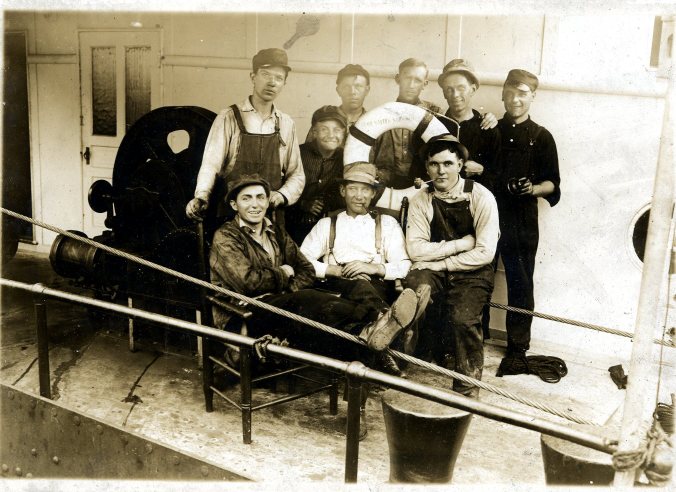
The crew of the Walter Scranton. Andrew Anderson is holding the life ring
Andrew, my grandfather, was a thirty year old young man. He was a sailor on at least two Great Lakes steamers in Michigan after coming to the United States and worked on several schooners while still living in Norway. He had been working aboard ships for seventeen years. I can not be absolutely sure when he stopped sailing but on his WW1 draft record in 1918 his occupation is listed as Substation Operator for DU Railroad. While I was researching this weekend, I found a horrific weather event which occurred in November of 1913. This event would surely have made anyone question why they would want to sail the Great Lakes for a living.
This weather event was much like “The Perfect Storm“ depicted in the movie which was release in 2000. If you have never seen it, check it out. The movie, The Perfect Storm, occurs in the northern Atlantic but the storm known as the White Hurricane occurred in the Great Lakes with the most severe conditions located in the Lake Huron region. No other storm has struck Lake Huron with the power that this storm had. It took 235 lives and there were 40 ships wrecks, 8 of which were large Lake Freighters which sank in Lake Huron. The following is an excerpt of reporting of this historic storm that I found online.
This fall storm began on November 7th and raged through November 12, 1913. It started as two separate weather systems, a rather weak low pressure system tracked east across the southern U.S., November 6th through the 8th, while a low pressure area and associated Arctic front moved south out of Canada and approached the northern Great Lakes by Friday morning, the 7th. The air behind the Arctic front was extremely cold for November which plunged temperatures into single digits across the Northern plains. A storm warning was issued on Friday, November 7th at 10 AM because of very strong winds which were expected as the Arctic front approached and were expected to continue after the front passed through. A large dome of high pressure extended from Canada south to the northern Rockies. While the low pressure and the Arctic front moved across the Great Lakes on Saturday, November 8th, storm force winds gusting to 50 knots battered the Great Lakes as it moved first from the southwest while shifting to the northwest. Winds with gusts over 50 knots were accompanied by snow squalls and blizzard conditions, yet the worse was yet to come.
Storm Warnings continued to fly over all the Great Lakes as northwest winds of extreme velocity turned to the north and churned the waters viciously. An enormous area of snow and blinding snow squalls developed across the Great Lakes as the Arctic front blasted its way across the relatively warm waters of lakes. The blizzard conditions buried the Lake affected communities with over two feet of snow and huge drifts. Port Huron, which usually gets Lake effect snow from Lake Huron with mainly a northeast or north wind, got buried with heavy snow and snow squalls creating 4 to 5 foot drifts which immobilized the city. Marine City where Addie and Andrew Anderson lived was due south of Port Huron a mere 19 miles.
By Sunday afternoon the wind at Port Huron, at the base of Lake Huron, increased steadily with maximum winds averaging 40 to 50 mph early Sunday afternoon and increased even further to 50 to 60 mph later that afternoon and continuing throughout the evening until to almost midnight. A maximum wind of 62 mph was recorded in Port Huron at 9:02 pm with similar readings at Harbor Beach.
In Detroit, they recorded a steady increase of the average wind to 45 mph with gusts of 70 mph recorded. Keep in mind, these readings were recorded on land not at sea. It was at this point of the storm when the Lake Carrier Association filed the following report which best summed up the Great Lakes ” white hurricane”:
“No lake master can recall in all his experience a storm of such unprecedented violence with such rapid changes in the direction of the wind and its gusts of such fearful speed!
Storms normally of that velocity do not last over four or five hours, but this storm raged for sixteen hours continuously at an average velocity of sixty miles per hour, with frequent spurts of seventy and over. Obviously, with a wind of such long duration, the raging violent seas that were created were such that the lakes are not ordinarily acquainted with. The testimony of masters is that the waves were at least 35 feet high and followed each other in quick succession, three waves ordinarily coming one right after the other. They were considerably shorter than the waves that are formed by an ordinary gale. Being of such height and hurled with such force and such rapid succession, the ships must have been subjected to incredible punishment!”
As stated earlier, approximately 235 people lost their lives on the ships with most of them from the eight large freighters (for that time) sunk on Lake Huron. They include the John McGean, Isaac M. Scott, Argus, Hydrus, James Carruthers, Wexford, Regina and Charles S. Price. Most of the vessels sank over central and eastern Lake Huron, in Canadian waters.
As I read about this storm, all I could think about was where was my Grandfather at the time. Was he aboard the Walter Scranton, the steel hulled vessel which measured 416 feet in length and was 50 feet wide? Or was he lucky to have been held in port somewhere? The only storm warning system in place at this time were flags that were flown at strategic points along the shoreline of the Great Lakes. As this storm raged, there was no hope of seeing a warning flag. If you were on the Lake, you were stuck in it if you could not get to port.
My next thought was for my Grandmother and her year old child, Olga. What fear she must have felt if Andrew was indeed somewhere on the lakes. I can not imagine.
So starting tonight, Sunday, November 10, 2019, our own storm will rage over Lake Huron. Snow fall should begin overnight and the Winter Storm Warning goes into effect beginning at 4 AM Monday morning and it will likely go until Tuesday Evening. Lake Huron is at an all time high level this season. We have had lots of shoreline flooding and erosion. We expect that to continue depending on the direction of the wind. A northerly wind is expected at the beginning of the storm but as the two front converge, we will have to watch and see what happens.
I am retired so I have no where to go and can sit in my warm house and watch out the window. If we loose power, we have a generator and we do not lived right along the lake so we have no worry about flooding.
The ships of today are much different than those of 1913 but it was a gale much like this one on Lake Superior forty four years ago today that brought down the Edmund Fitzgerald. I have an app on my iPhone called Marine Traffic that I use to watch the freighters as they navigate the Great Lakes. Currently listed on my App are nine freighters in Lake Superior which are currently southbound. There are two new ships entering through the locks and three exiting into Lake Huron. There are six southbound freighters in Lake Huron and four northbound. There are also six tugs in different locations in Lake Huron tonight. Freighter traffic is light in Lake Michigan tonight. Seven ships are in Port at various locations on the Michigan, Illinois and Wisconsin shorelines. There is one ship in the shipping lanes, the Cason J. Callaway whose destination in Calcite (US) which is a port on Lake Huron, south of Rogers City, Michigan and another ship, Stewart J. Cort, running along the Michigan shoreline headed to Duluth on Lake Superior. The Cason J, Callaway’s expected arrival is 19:00 UTC tomorrow. I will keep an eye on the progress of this ship and all the others in Lake Huron tonight.
On land in the Thumb, it will be difficult few days for our farmers. There are many fields that still need to be harvested. The predicted amounts of snow, eight to 12 inches will make that a very difficult process. For now all we can do is wait and see.
Happy Hunting,
Jan
 Needles in a Haystack