Ever wonder how Halloween got started…Ghost, Goblins, Devils, Witches, Spirits…Me too so I googled it and the History Channel came back with a pretty interesting article on it.
Halloween is thought to have originated with the ancient Celtic (pagan) festival of Samhain, when people would light bonfires and wear costumes to disguise themselves and ward off spirits of the dead or ghosts. In Celtic tradition, this day marked the end of summer and the harvest and the beginning of the dark, cold winter. Celts believed that on the night before the new year, the boundary between the worlds of the living and the dead became blurred. It was on the night that they celebrated Samhain, that the Celts believed that ghosts of the dead returned to earth.
Celts thought that the presence of the otherworldly spirits made it easier for the Druids, or Celtic priests, to make predictions about the future. For a people entirely dependent on the volatile natural world, these prophecies were an important source of comfort and direction during the long, dark winter.
To commemorate the event, Druids built huge sacred bonfires, where the people gathered to burn crops and animals as sacrifices to the Celtic deities. During the celebration, the Celts wore costumes, typically consisting of animal heads and skins, and attempted to tell each other’s fortunes. When the celebration was over, they re-lit their hearth fires, which they had extinguished earlier that evening, from the sacred bonfire to help protect them during the coming winter.
By 43 A.D., the Roman Empire had conquered the majority of Celtic territory. In the course of the four hundred years that they ruled the Celtic lands, two festivals of Roman origin were combined with the traditional Celtic celebration of Samhain.
The first was Feralia, a day in late October when the Romans traditionally commemorated the passing of the dead. The second was a day to honor Pomona, the Roman goddess of fruit and trees. The symbol of Pomona is the apple, and the incorporation of this celebration into Samhain probably explains the tradition of “bobbing” for apples that is practiced today on Halloween.

ALL SAINTS DAY
On May 13, 609 A.D., Pope Boniface IV dedicated the Pantheon in Rome in honor of all Christian martyrs, and the Catholic feast of All Martyrs Day was established in the Western church. Pope Gregory III later expanded the festival to include all saints as well as all martyrs, and moved the observance from May 13 to November 1 around 1000 AD. It’s widely believed today that the church was attempting to replace the Celtic festival of the dead with a related church-sanctioned holiday, All Saints Day. In England, All Souls Day was celebrated similarly to Samhain, the last day of October, with big bonfires, parades, and dressing up in costumes as saints, angels and devils.
The All Saints Day celebration was also called All-hallows or All-hallowmas (from Middle English Alholowmesse meaning All Saints’ Day) and the night before it, the traditional night of Samhain in the Celtic religion and All Souls Day in England, began to be called All-Hallows Eve and, eventually, Halloween.

HALLOWEEN COMES TO AMERICA
Celebration of Halloween was extremely limited in colonial New England because of the rigid Protestant belief systems there. Halloween was much more common in Maryland and the southern colonies.
As the beliefs and customs of different European ethnic groups as well as the American Indians meshed, a distinctly American version of Halloween began to emerge. The first celebrations included “play parties,” public events held to celebrate the harvest, where neighbors would share stories of the dead, tell each other’s fortunes, dance and sing.
Colonial Halloween festivities also featured the telling of ghost stories and mischief-making of all kinds. By the middle of the nineteenth century, annual autumn festivities were common, but Halloween was not yet celebrated everywhere in the country. In the second half of the nineteenth century, America was flooded with new immigrants. These new immigrants, especially the millions of Irish fleeing the Irish Potato Famine, helped to popularize the celebration of Halloween nationally.
TRICK-OR-TREAT

The American Halloween tradition of “trick-or-treating” probably dates back to the early All Souls’ Day parades in England. During the festivities, poor citizens would beg for food and families would give them pastries called “soul cakes” in return for their promise to pray for the family’s dead relatives.
The distribution of soul cakes was encouraged by the church as a way to replace the ancient practice of leaving food and wine for roaming spirits. The practice, which was referred to as “going a-souling” was eventually taken up by children who would visit the houses in their neighborhood and be given ale, food and money.
The tradition of dressing in costume for Halloween has both European and Celtic roots. Hundreds of years ago, winter was an uncertain and frightening time. Food supplies often ran low and, for the many people afraid of the dark, the short days of winter were full of constant worry.
On Halloween, when it was believed that ghosts came back to the earthly world, people thought that they would encounter ghosts if they left their homes. To avoid being recognized by these ghosts, people would wear masks when they left their homes after dark so that the ghosts would mistake them for fellow spirits. In an effort to keep ghosts away from their houses, the English people would place bowls of food outside their homes to appease the ghosts and prevent them from attempting to enter.
Borrowing from Irish and English traditions, Americans began to dress up in costumes and go house to house asking for food or money, a practice that eventually became today’s “trick-or-treat” tradition.
In the late 1800s, there was a move in America to mold Halloween into a holiday more about community and neighborly get-togethers than about ghosts, pranks and witchcraft. At the turn of the century, Halloween parties for both children and adults became the most common way to celebrate the day. Parties focused on games, foods of the season and festive costumes.
Parents were encouraged by newspapers and community leaders to take anything “frightening” or “grotesque” out of Halloween celebrations. Because of these efforts, Halloween lost most of its superstitious and religious overtones by the beginning of the twentieth century.
HALLOWEEN PARTIES

Halloween Party – 1920
By the 1920’s and 1930’s, Halloween had become a secular, but community-centered holiday, with parades and town-wide Halloween parties as the featured entertainment. Despite the best efforts of many schools and communities, vandalism once again began to plague some celebrations in many communities during this time.
By the 1950s, town leaders had successfully limited vandalism and Halloween had evolved into a holiday directed mainly at the young children. Due to the high numbers of young children during the fifties baby boom, parties moved from town civic centers into the classroom or home, where they could be more easily accommodated.

Halloween – 1948
And in the 1940’s and 1950’s, the centuries-old practice of trick-or-treating was also revived. Trick-or-treating was a relatively inexpensive way for an entire community to share the Halloween celebration. In theory, families could also prevent tricks being played on them by providing the neighborhood children with small treats.
BLACK CATS

Shadow and Midnight – 2008
Today’s Halloween ghosts are often depicted as more fearsome and malevolent, and our customs and superstitions are scarier too. We avoid crossing paths with black cats, afraid that they might bring us bad luck. This idea has its roots in the Middle Ages, when many people believed that witches avoided detection by turning themselves into black cats.
We try not to walk under ladders for the same reason. This superstition may have come from the ancient Egyptians, who believed that triangles were sacred (it also may have something to do with the fact that walking under a leaning ladder tends to be fairly unsafe). And around Halloween, especially, we try to avoid breaking mirrors, stepping on cracks in the road or spilling salt.
Modern Day Halloween
Fifteen years ago, Greg and I began taking our popup camper to Door County, Wisconsin for Columbus Holiday Weekend (first Weekend in October) to go camping for our final trip of the season. We went there annually for about ten years, Egg Harbor had a large pumpkin festival and the local campground took advantage of the weekend by having it’s own Halloween festival. They had hayrides, pumpkin carving events, campsite decorating contests and Trick or Treating! We would haul our Halloween decorations and fix the campsite into a Haunted cemetery. It was so fun. We looked forward to our last camping event. It was often really cold and sometimes we even had flurries! It was probably the only time we ever used the heater in the camper.

Door County, Wisconsin – 2004
We did not camp for a few years in the fall until we moved to Harbor Beach and decided to camp at our local campground and invite the Grandsons to come join in on the fun. We start our Halloween season this year the last weekend of September. Christa and the boys came up to camp with us. It is fun to build special memories with the boys that revolve around Halloween and camping!
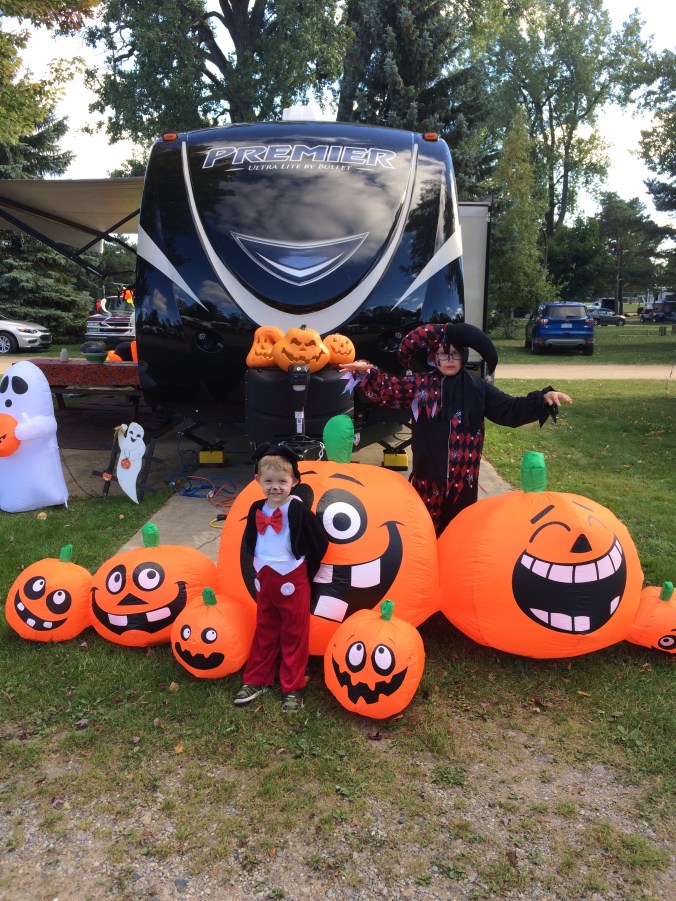
North Park, Harbor Beach – 2017
My husband goes to great lengths to decorate for Halloween at our home too. Most of his decorations are of the blow up balloon variety…with the exception of a few other props that we have collected through the years. My brother-in-law is very creative and he makes very real looking witches and scary figure. He made one for me and she sits proudly on my porch guarding the house.

My husband found the witch from the Wizard of Oz or Wicked online so he added her to our collection….so she stands guard too.

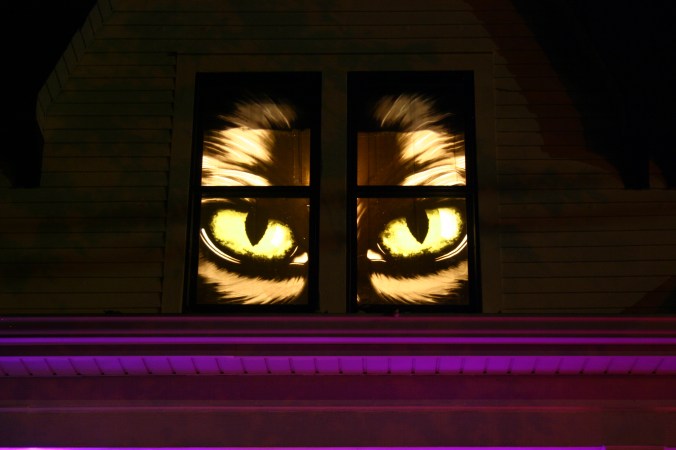
It is fun to see the reaction of all the kids as they come up on the porch in search of a treat. We are lucky to be living in a small town where kids can still safely go from house to house. We added black cat eyes to honor our black cats, “Midnight and Shadow” who used to love their own special holiday!
I hope that you have enjoyed this blog about Halloween. I learned quite a lot about the holiday and since we have Irish roots, I think it is appropriate that we are carrying on old traditions!
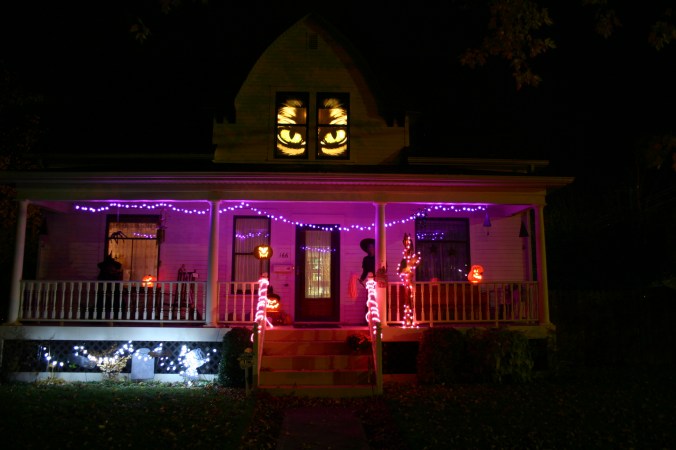
Halloween – 2014
Happy Halloween!
Jan
 Needles in a Haystack