Norway Bucket List – Part Four

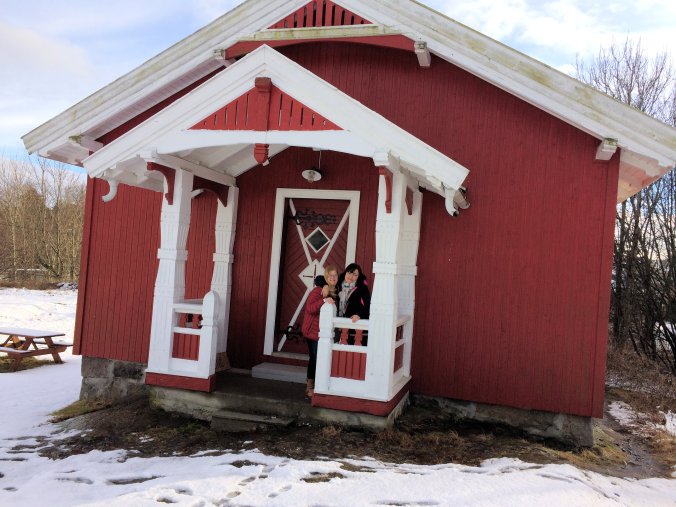
After leaving the Tjome Church, Inger took us to the Historical Society which was just a few minutes away. In 2011, I wrote a chapter for their bi-annual book on Tjome. They were looking for a story about someone from Tjome who immigrated, and when Inger and I connected, they found their story. This red cottage was relocated to this land which is owned by the historical society.
IMG_4745

This building is full of historical information about sailing, fishing and how the people of Tjome made a living on the Oslo Fjord. It was very interesting and a huge part of our family story.  For as far back as I can track the records of our family on Tjome, they all worked at something which involved the sea.  They were fisherman, they were deck hands, seaman or captains.  They took people from one place to another or moved goods from one place or another.  They all sailed.  Hans was a sailor and so too were his sons, our Grandfather, Andres and his brother, Hagbart.  Hagbart died at sea near the Cape Horn when he was twenty on a sailing ship bound for Australia in March of 1909. This building with it’s special displays dedicated to the sailors of Tjome, was a special treat.

IMG_4741

They have several houses and a barn on the property. This is a typical Norwegain home at the turn of the century on Tjome.

IMG_4752

As we entered the front door, we could not miss the tapestry hanging on the wall.  A beautiful family crest of a proud Norwegian family above a large sailors trunk.  Notice the musical instrument hanging on the wall and the large farm bell! It was all a warm welcome to this wonderful home.
IMG_4749

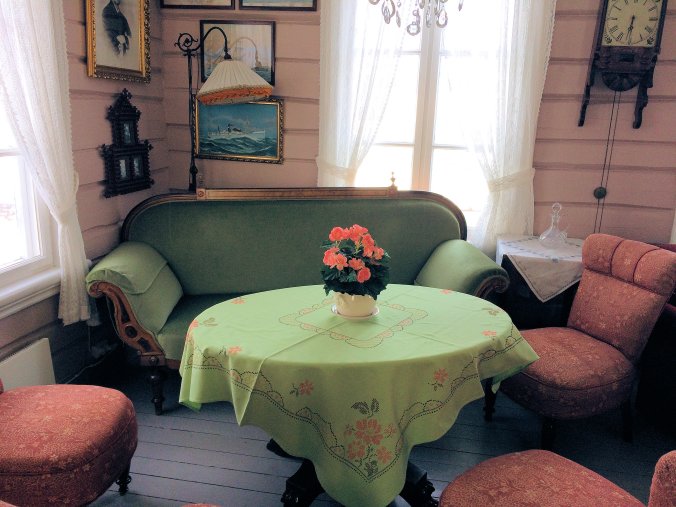
The home had a small sitting room, the green sofa is a piece that has been handed down through Inger’s Family which she donated to the Historical Society.
IMG_4753

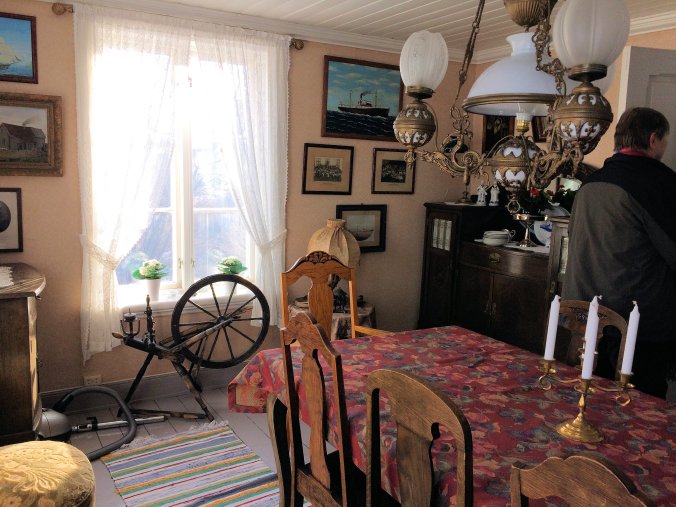
Typical Norwegian dining room. Today, families throughout the Scandinavian countries, still all sit at the table for dinner every night.  Most families have candles on the dinner table which are lite for every meal. It is a wonderful tradition which has been lost in America with the rushed life that we live. We have a hard time finding all of our children much less time to all sit at a table for a meal…and set the table with real dishes, silverware and napkins. We need to bring our families back to the dinner table.

IMG_4755

A beautiful old sideboard used to store dishes, silver and linen for the dining room.

IMG_4757

And a sunny Kitchen with a small table which was probably used to have tea or coffee, a snacks for the children after school and to prepare meals on. You could just imagine the children sitting at the table telling Mom how their day went at school.

It is a great compact home full of warmth left behind by the family who lived within the walls….

From the Historical Society, we returned to Inger and Eva home for lunch. …well, it was really more like an early dinner by then but we enjoyed a traditional Norwegian meal made for us by Eva, bless her heart while we trouped around Tjome with Inger.
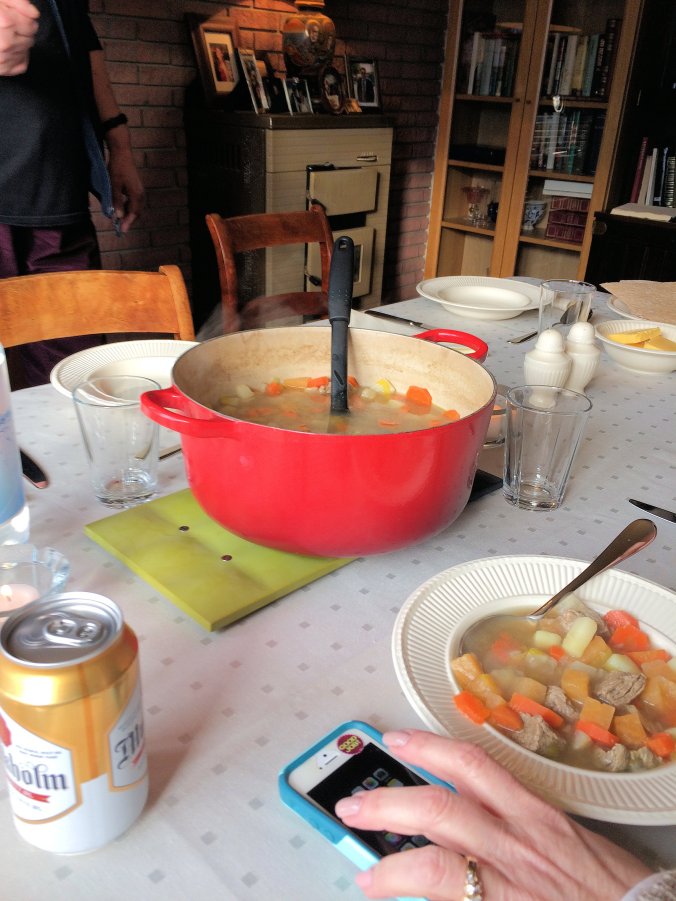
IMG_4764

Inger called it “Storm Soup”. It was wonderful and warmed us up nicely inside.  As I savored those first few bites of soup, I thought this would be a great recipe to get so that once we arrived home I could make it.  It would help use to remember this wonderful day!  So I asked for the recipe and she smiled. Inger knew I would ask for it. I do it all the time through email when we talk about our gardens and what we are growing and eating! She smiled…and replied “ Sailors would make this soup on board a ship when a storm was coming” They would throw everything that had in a big pot and put it over the fire or stove to simmer. “It was always a BIG pot because they never knew how long the storm would last or when they would get to cook again.” She told us. “If the storm was short, they would eat it until they were sick of it but if the sea raged and the storm kept up, the sailors were thankful for a hardy soup which warmed them from the inside out and gave them strength to keep manning the ship.” “Sailors would often use fish or beans and all the vegetables they had on hand. Today we have beef, tomorrow it could be pork or chicken!” , she laughed as she told us the story about the soup.

So the recipe is just like what we would make when a winter storm hits. At a time when you can not go to the store to buy specific ingredients so you search through your cupboards and make soup with what ever you have! I will think of Storm Soup every time I make it!  It was the end of a wonderful day on Tjome and time for us to say our …. “till next time!” to Eva and Inger, knowing that we will return again.

Next time we want it to be summer.  Next time …we want our stay to be for several days or a week so we can really explore this island that our family called home for many generations. Next time, I want to sail in the Fjord like my ancestors did!

Till next time…Happy Hunting,

Jan

Norway Bucket List – Part 3

It’s a cool, gray day in Michigan today. One of those days where you think it’s gonna rain anytime so you don’t water the garden….and then it doesn’t so maybe you should have. Even though the calendar says June 6, 2017, it feels more like April. The gardening can wait for a warmer day later in the week.

I really need to get my Norway Bucket List – Part 3 post written and published. I had planned to have it done long before now but life has gotten in the way. In the last few weeks, the sun has risen on the horizon and the days are longer. The ground is warming and the weeds in the garden and the flower beds have woke up. The yard has come alive with activity and that means work for me. I’ll take this opportunity today try to get this done…

So let’s go back to where we left off in late February, with our visit to Tjome. After leaving the house of our Great-Grandfather, Hans Andersen, Inger’s plan was to escorted us to the Tjome Kirke (Church) where all of our ancestors were baptized and buried. On our way to the church, she decided to take a brief stop at a small house. This house was of special interest to our cousin Rita because it was the house her Grandmother was born in and spent her childhood in. Rita’s Grandmother was Anna Charlotte Skafjeld Andersen.  This was the Skafjeld home.

IMG_5506

As we exited our car, there it is… the front door of the house. There was not enough room to park the car safely on the side of the road so Zach pulled up a little ways until he could get the rental car off the road.

IMG_5508

Anna’s childhood home

It was a cute house but today it sits right on a two lane highway. As you can see from the picture there is no more than a few feet between the front door and the two lane street. “It is for sale”, Inger tells Rita. Rita laughs and says she doesn’t want to live in the road. Times have changed, I am quite sure that in Anna’s time it was a quiet little lane and a wonderful place to grow up.

When my parents visited Norway in 1973, Anna brought them to Tjome and gave them a tour of the island. Anna was the last living relative from my Grandfather’s generation when Mom and Dad visited. It has been fun to look at Mom and Dad’s photos of Tjome and compare them to our photos.

Anna’s son Bjarne, Rita’s father is the last living relative from my Mother’s generation which was what made this trip so important. Important to see him, important to meet our cousins from our generation while he is still with us and important to introduce the next generation of our family in America to our Norwegian family in Norway. All of these things we did that day!

From there we went to the Church and the cemetery.

IMG_4733

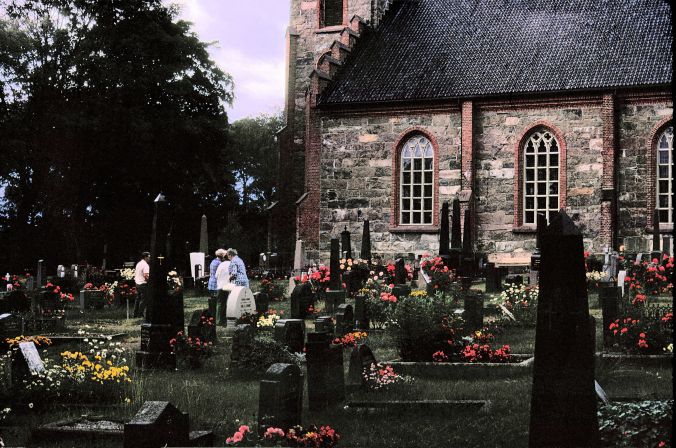
Tjome Church

From the early 1600’s through nine generations of our family, the Tjome Church has been apart of our family. In the record books kept by the clergy of this church, you see the family as it has grown through the births, baptisms, weddings, and eventually through the deaths and burials. Most all of these family members are buried in this cemetery. Many of the men were sailors. Some were lost at sea or were buried at sea but the event was recorded here. It is an amazing building. Our families climbed the stairs and opened the doors and worshiped within the walls. I wish we could have gone inside. Next time we will be there on Sunday, so we can. As we walked the grounds, we could feel the presence of all the people who were there before us.

When Mom and Dad were here in 1973. The church looked much the same but the cemetery looked different. It was, of course, a different season, summer rather than winter. They were able to enter the church. Their visit was at a time when you could leave a church unlocked and people could enter the house of God when they wanted or needed.  Today it is locked unless it is in use just as the churches in America are.

FamilyCemeteryatTjomeChurch-edit

Cemetery in 1973 with Mom, Anna, Tormod and Auslag searching for Han’s grave.

I wish I knew if they were standing in front of Han’s grave. I did not have this photo with me when we were there. Not that it matters because we still would not know for sure if this was the exact site of his grave. Luckily, they did take a photo of his tombstone when they found it.

HansAndersenstone

IMG_4724

The Tjome Church from the back of the cemetery in February 2017

We searched for tombstones just as they did. We searched and searched for it, but it is gone. It is the custom in Norway that family graves are only persevered if there is money to maintain them. If the family stops paying to maintain them then the stones are removed and the grave site recycled…(that is so hard to say) We, American found this to be a very difficult reality.  In this space, in this ground, we have nine generations of family member’s remains, the cemetery is not that large so what else could they have done. It is a small island of rock and with a little dirt and sand. Here in this place, it is literally ashes to ashes…

Zach-TjomeChurch-2017

Zach searching for Hans tombstone

In the back of the cemetery there is a row of stones which have been removed from graves and we searched through those too, in hopes of finding Hans’s tombstone. The physical evidence that he was here. We did not find it.

It was a peaceful place where we all felt that we belonged. We lingered as long as we could. The sun sank in the western afternoon sky and the cold air began to creep into our bones. Eventually, we knew it was time to leave. We will come again in the summer, when its warmer and next time I’ll bring the 1973 picture. Not that it will matter because as you stand there you feel them all around you. You know they are there and they know that you are too!

Part 4 coming soon…they day is not yet over.

Love,  Jan